
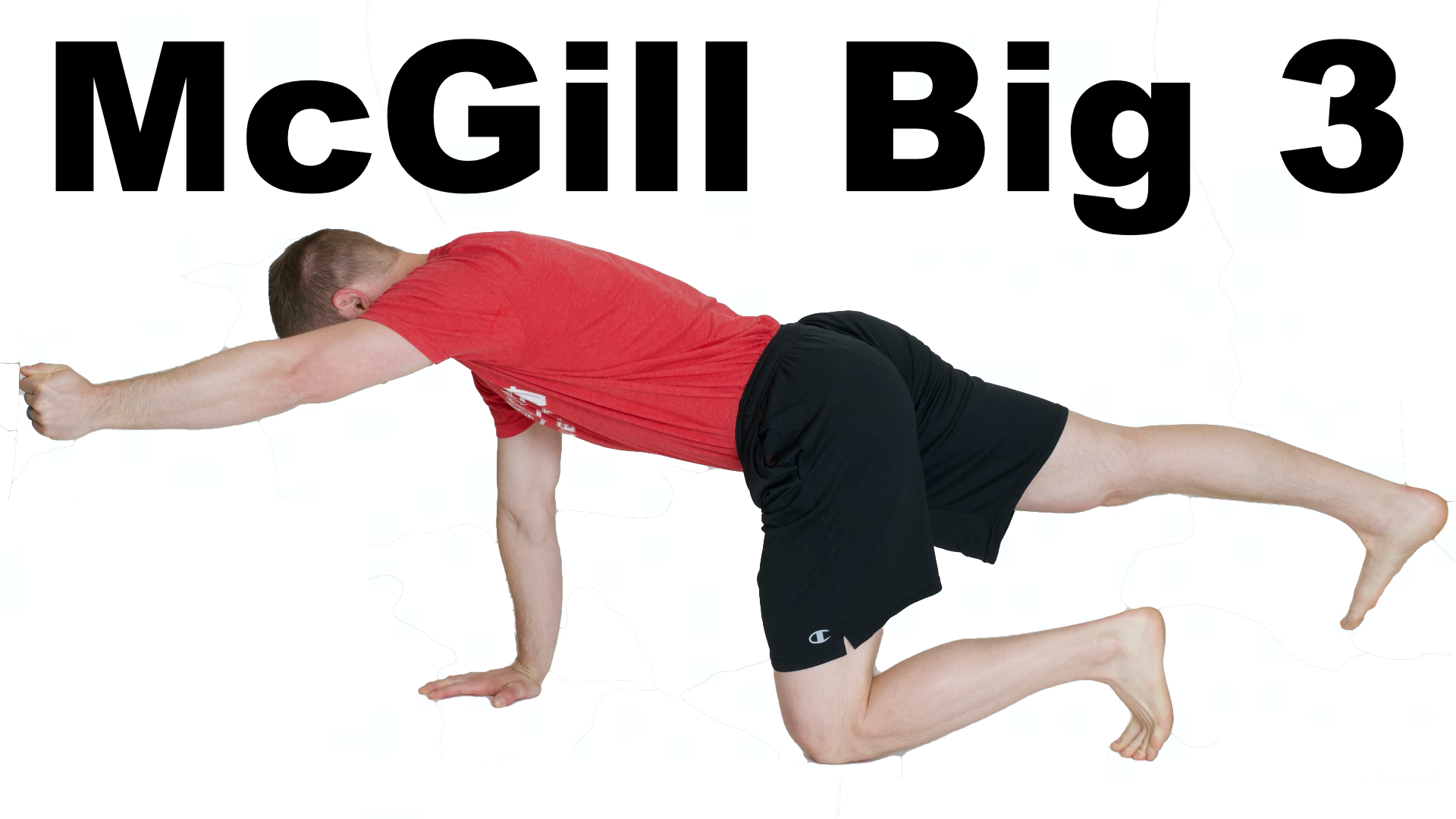
For the last few weeks, we have been discussing the topic of low back pain. In our most recent article, I unveiled a simple step-by-step protocol screening your back along with a few ways to start winding down your symptoms. Today I want to share how to start fixing your injury so you can return safely to barbell training.
In my career as a physical therapist, there are few who have had a greater impact on how I approach treating low back injuries as Dr. Stuart McGill of Waterloo University. Over the past few decades he has written extensively on the topic of back injuries and the concept of core stability (in books such as Ultimate Back Fitness and Performance and Back Mechanicas well as in countless professional journals articles – visit www.backfitpro.com).1While I want to briefly go over the basics of each with you today, I highly suggest diving deeper into these topics with his publications.
Complete Rest Is Never A Fix
Think about the last time you went to your family doctor with a complaint of pain. If you experienced that pain while lifting a barbell, there’s a good chance the doc uttered these words, “I recommend not lifting for a few weeks.” Sound familiar?
It’s true many find some short-term relief of their symptoms by following these orders. It makes sense on paper. If deadlifting causes your back to hurt, not deadlifting will likely decrease your pain! Problem solved right?
Wrong.
While eliminating what triggers your pain for a few weeks will likely decrease your symptoms, it is never a final solution. Chances are the pain will eventually return because you never addressed why the problem started in the first place.
Eliminating the movement, posture or load that causes your pain is only half of the battle in fixing any injury. Anyone can tell you to stop doing something that hurts. Eliminating symptoms and building your body to become more resilient to future injury requires a different and more active approach.
To kick-start this active approach, let’s start by learning about our body’s ‘core’ and how it’s function relates to both the cause and fix of injury.
What is ‘core stability?’
Imagine for a moment a symphony orchestra composed of countless musicians. Just as each and every person must play their instruments in a united manner with constant changes in tempo and volume, our body must too coordinate each and every muscle and joint to create purposeful and sound movement.
The muscles that surround our spine are considered the “core” of our body. It is composed of the abdominal muscles on your front and sides, the erector muscles of the back and even the larger muscles that span multiple joints (like the lats and psoas muscles). It may surprise you that the glutes are also an important part of the ‘core’ (something you’ll learn about very soon!). Each and every one of these muscles must work together in order to enhance the stability of the spine. But what really is ‘stability’?
Spinal stability is something Professor McGill has been able to define and measure with his work. First, when muscles contract they create force and stiffness. It is the stiffness part that is important for stability. Think of the spine as a flexible rod that needs to be stiffened to bear load. This is the role of the muscles. Through his research, he has measured athletes who fail to obtain appropriate muscular stiffness around the spine by coordinating muscle activation, and their subsequent injuries and pain.
Second, our body functions as a linked system. And distal movement requires proximal stiffness. Consider trying to move a finger back and forth very quickly – the wrist needed to be stiffened otherwise the entire hand would move. Now using the same principle consider the action of walking. The pelvis must be stiffened to the spine otherwise the left hip would fall as the left leg swings forward to take a step. This core stiffness is non-negotiable to enable walking. Thus all body movement needs appropriate coordination of muscles. To move, run, or squat requires spine stiffness and core stability.
When the core fails to meet the stability demands placed on the body during a certain lift, parts of the spine will be overloaded with forces that increase injury risk and performance will suffer. Much like a trumpeter squealing off pitch and out of tune would instantly dismantle the entire orchestra’s sound, each and every muscle that surrounds the spine must play it’s part in maintaining our body’s own “symphony of movement” in order to produce safe and powerful movement.
Where Do We Start?
There are two general approaches many will take to address a weak link of the core. The first (and most common method you’ll see in fitness clubs across the world) is through dynamic strengthening exercises such as crunches, back extensions or Russian twists. Traditionally coaches and medical practitioners have used these exercises that build strength through movement with the mindset that a stronger core will give the spine less chance for buckling and breaking under tension.

To a point this is true. Each muscle that surrounds the spine does need to have sufficient amount of strength to contract and ‘turn on’. When the muscles of our core contract, stiffness is created. Much like a guy-wire that attaches and holds up a radio tower, each muscle that surrounds the spine must provide a certain amount of tension and stiffness to maintain the strength of the spine as a whole and keep it from buckling and becoming injured.

However, here’s what most people don’t understand. Many people who develop back pain already have strong backs!4 While exercises like Russian twists, sit-ups or back extensions from a GHD machine may be great at increasing strength, they do little to increase core stiffness.8
In order to enhance the quality of stiffness, one must train the core differently. This comes through the second approach of using isometric exercises built to enhance muscular endurance and coordination.
An ‘isometric’ describes when a muscle or group of muscles are activated and contracted but there is no change in the joints they cross. For example, during a side plank the lateral oblique and quadratus lumborum (QL) muscles are very active yet the spine and hips remain still and do not move. Research has found that isometric exercises to enhance muscular endurance are far superior when compared to dynamic strengthening exercises in enhancing spinal stiffness and stability (making them ideal not only for rehabilitation of back injuries but also in the training and enhancement of athletic performance).8
This is because the core functions to limit excessive motion (especially in barbell lifting) rather than creating it. Therefore, the traditional way in which the fitness and rehab world has approached addressing the core for years has been completely backwards! This is why someone can have a ripped six-pack and yet have poor core stability when it comes to deadlifting or performing a squat.
In order to stiffen the torso and limit excessive motion, every muscle of the core must co-contract or work together. When this is done correctly through a bracing action, your body creates it’s natural “weightlifting belt.” Not only will this stiffen your spine and keep it safe when performing heavy lifts (like a squat or deadlift) it will also help transfer force throughout your body. For example, a weightlifter performing a jerk requires sufficient core stability in order to transfer the power he or she generates from their legs through the core and into the upward drive of the barbell.
All For One, And One For All
Much like the symphony orchestra illustration from before, each and every muscle of the core has a role to play, but none is more important than the other. For this reason, proper stability training should not focus on one specific muscle. For decades, medical practitioners were incorrectly taught to focus and isolate certain muscles such as the transverse abdominus (TA), multifidus, or QL in an effort to enhance core stability. This method however, is flawed for a number of reasons.
First, research has shown it is impossible for an individual to solely activate one specific muscle of the core. Despite what your physical therapist or doctor says, you cannot train your multifidus, QL or even your TA muscle in isolation.
Even it were possible to target a specific muscle of the core (as some would argue is possible through exercises like abdominal hollowing), methods like this have been shown to be far less efficient in creating stability for the spine compared to abdominal bracing (contracting all of the core muscles together).15
The Big 3
Now that we know what type of exercises are superior for rehabbing back injuries, it’s now time to discuss which exact exercises to start with! There is unfortunately no “one size fit’s all” when it comes to core exercises because there is no one universal movement that equally stresses all of the muscles that surround your spine. For this reason, we must utilize a regime of exercises to efficiently work all of them.
In his years of studying the spine, Dr. McGill has found there to be three specific exercises that most efficiently address all of these areas without placing excessive stresses on the parts of the back that may be aggravated or irritated due to injury. This group of exercises has famously become known as ‘The Big 3.’
- Curl-Up
- Side Plank
- Bird-Dog
Mobility First
Before I describe each of these recommended core stability exercises, it is suggested to first decrease any significant mobility restrictions at the hip and thoracic spine.
If mobility in either of these areas is limited it can lead to movement compensations at the low back. For example, if there is limited hip mobility during the squat motion the pelvis can be pulled underneath (posterior pelvis tilt) causing the lower back to leave its neutral position and round.
For this reason, if you only performed core stability work but did not address any significant mobility restrictions in joints above or below the lumbar spine, the stiffness you created will always be short-lived.
Another mobility movement Dr. McGill recommends you perform before the Big 3 to reduces low back stiffness and improve motion of the spine is a ‘Cat-Camel.’ Unlike other stretches for the low back that can place harmful stresses on the spine, this exercise emphases mobility in a very spine-friendly manner.
Step 1: Assume an all-4’s (quadruped) position on your hands and knees.
Step 2: Slowly arch your entire spine and hips as high as possible without pain into a flexed or rounded position. You should end with your head looking down towards the ground. This is the camel position. After pausing for a few seconds move into the opposite downward extended position with the head looking up (the cat). Make sure you only move into a light stretch for each position and do not force your spine into any pain.
Perform 5-6 cycles of this exercise before moving on to starting the Big 3 with the curl-up.11
The Curl Up
When most people perform what they have been taught to be a ‘curl up’ they bend or flex their entire spine and attempt to bring their chest towards their knees. While this exercise does activate the anterior core muscles to a great degree (especially the rectus abdominis or 6-pack muscle) the ‘crunch’ motion does a few things that isn’t so appealing especially for those currently dealing with back pain.
First, the motion of the classic curl up places a large amount of compression on the spine that can flair up symptoms for those who are ‘load intolerant.’ (refer back to the previous blog on screening your low back to see if this describes your back injury).17
Second, the motion also pulls the spine out of its neutral slightly arched position and flattens it into a bit of flexion. If your low back symptoms increase with bending of the spine (a term called ‘flexion intolerance’) this motion should be avoided at all costs.
The traditional curl up also relies heavily on the psoas muscle of the anterior hip to pull the torso towards the thighs. So while you think you may be isolating and sculpting that sexy 6-pack by doing endless crunches, you’re actually doing a really good job of strengthening your hip flexors.16
A way we can still hone in and focus our attention to improving the stabilizing ability of the anterior core muscles in a more efficient way is to perform a modified curl up.
Step 1: Lie on your back with one knee bent and the other straight. If you currently have pain that radiates down one leg, flatten that leg out against the ground. Place your hands under your low back (this will ensure your spine remains in a neutral slightly arched position during the next step).
Step 2: Pick your head off the ground only a few inches and hold that position for 10 seconds. If you’re resting your head on a pillow, imagine it as a scale and lift your head off of it only enough to make it read “zero” on the dial or screen.2 The goal is to perform this curl-up without any movement in the low back! If you raise your head and shoulders too high (like a traditional curl-up or crunch) your low back will round and excessive forces will be transferred to the spine that could increase your symptoms.

Step 3:After a 10 second hold, relax your head back down to the resting position.
You can progress this exercise and increase the difficulty by bracing your abs before moving you head or raise your elbows from the ground to decrease your base of stability.3

How Many Reps To Perform
Unlike training for pure strength or power, the endurance component of stability requires the body to perform many repetitions of an exercise in order to see improvements. Dr. McGill advocates for using a descending pyramid rep scheme with 10-second isometric holds in order to enhance stability without fatiguing and over-working the body.
An example program would be to perform five reps, then three, and finally one to end (each with an 8-10 second hold). Rest between each set for 20-30 seconds. As this rep scheme becomes easier, it is recommended to increase the amount of repetitions rather than the duration of the holds in order to build endurance without causing muscle cramping.3This can be freely modified to suit your current individual level of endurance and goals (for instance using a 6-4-2 or 8-6-4 rep scheme).
I have personally found this method of training the core to be very effective in the rehabilitation process of my own patients at Boost Physical Therapy & Sport Performance.
The Side Plank
After addressing the anterior core muscles, let’s now move to the sides of the body. The side plank is a unique exercise as it activates the lateral oblique and QL muscles on only one side of the body, making it an excellent choice for addressing weak links in stability while placing minimal forces on the spine. It also engages an important stabilizer of the hip/pelvis on the lateral hip (the glute medius).12
Step 1:Lie on your side with your legs bent and upper body supported through your elbow. Place your free hand on your opposite shoulder.
Step 2: Raise your hips so that only your knee and arm support your bodyweight.

Step 3: Hold this position for 10 seconds before returning back down. Perform the same descending pyramid rep-scheme for each side.
There are a number of fun progressions you can do with this exercise. You can start by moving your hand placement from your opposite shoulder to the top of your hips or even move to a full side plank (bodyweight supported by your feet and elbow).
Perform the full side plank with one foot directly in front of the other, because you can also take it one step further and incorporate a rolling pattern (where you would tilt or rotate your body towards the ground and back towards the ceiling) if the side plank alone is easy. Make sure to keep your shoulders, torso and upper leg in a direct line during this roll to keep the low back safe.
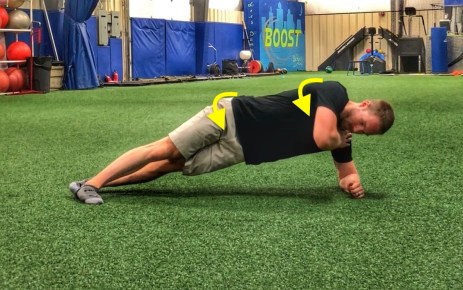
If you are unable to accomplish even the modified side plank (bridging from the knees) due to shoulder or arm pain, you can perform a side lying leg lift. Start by lying on your side, brace your core muscles appropriately and raise both legs off the floor together a few inches. Hold them for 8-10 seconds before relaxing down.

The Bird Dog
The last of the McGill ‘Big Three’ is the bird dog. This is an excellent exercise to promote a stable core while movement occurs at surrounding joints (either the legs or arms and legs together). The combination of movement occurring at the hips and shoulders while the low back remains stable allows this exercise to have excellent carry over to movements you perform throughout your day and in the weight room.
Step 1:Assume an ‘All 4’s’ position (quadruped) with your back in a neutral alignment. Remember a ‘neutral’ position is a very slight arch and not completely flat.
Step 2:Without allowing any movement to occur at the low back, kick one of your legs backwards while simultaneously raising the opposite side arm until both extremities are fully straightened. A helpful cue to make sure the leg movement doesn’t create an over-arching of your back is to think about kicking the heel of your foot straight back. Making a fist and contracting your arm muscles as you hold it in the extended position can also increase muscle activity of the core (especially of the erector spinae muscles).
If you are unable to perform the arm and leg movement together without pain or it is too difficult without losing balance, try the modified version with only leg movement.

Step 3:Hold each extended pose for 10 seconds before retuning back to the starting All 4’s position. You can also ‘sweep’ your arm and leg back underneath your body in between each repetition. Don’t let your back round during this motion but instead maintain the neutral spine position and allow the motion to only occur from the hips and shoulders! Again, perform the same descending rep-scheme as the previous two exercises.
You can progress this exercise by drawing a square with your outstretched hand alone or your hand and opposite foot together.
What About Low Back Stretching?
If you didn’t notice, the prior exercises to kick-start the rehabilitation process did not include any stretches for the back! Early in my career as a physical therapist, it was common to prescribe certain stretches (like pulling your knees to your chest while lying on your back) as an exercise for many with low back pain.
At the time this exercise made sense. Those who had difficulty standing for long periods or lying flat on their back often felt better when in a flexed position. Many who complained of feeling stiff and painful in their low back had instant relief of their symptoms after performing a few of these stretches.
However, I realized (after reading and studying from Dr. Stuart McGill) that this relief is only a temporary relief for most. When you stretch your low back, you are stimulating the stretch receptors deep inside the muscles that give the perception of pain relief and the feeling of less stiffness.
As I have written about in earlier blogs, most of the muscle pain and stiffness you may feel in your back is consequence of a chemical reaction called inflammation that occurs from the real injury located deeper in the spine (disc bulge, facet irritation, etc).5,6 The underlying injury is what causes the secondary contraction or spasm of the surrounding muscles and pain.
For this reason, rehabbing from a back injury for a large majority of athletes should aim to stabilize the core and reeducate proper movement to treat why the problem started rather than stretch the surrounding muscles to increase mobility of the low back and treat the symptoms.
Re-Awaken those Sleeping Glutes!
It is common to see athletes with back pain also have an inability to properly activate and coordinate their glute muscles. Simply put, the butt muscles can fall asleep.13When this happens the body naturally starts to use the hamstrings and low back muscles more to create hip extension (both are problematic in creating efficient movement and place excessive stress on the spine).1
If the single leg bridge test (from the prior blog on ‘Screening Low Back Pain’ exposed a problem in how your body coordinates and turns-on the glutes, the following exercises should help.
The Bridge
Step 1: Lie on your back with your knees bent as shown.
Step 2: Squeeze your butt muscles FIRST and THEN lift your hips from the ground. Picking your toes up and driving your heels into the ground can help increase your glute activation during this part of the movement. Squeeze your glutes as hard as you can in this bridge position for 5 full seconds before relaxing back to the ground. If you find your hamstrings cramp during this motion, bring your heels closer to your hips. This shortens the length of the hamstrings and gives puts them at a disadvantage to contribute to the movement (a concept called active insufficiency).14

Recommended sets/reps: 2 sets of 20 for a 5 second hold. Eventually work your way up to 10-second hold.
Deep Squat With Isometric Hold
Step 1: Hold a weight in front of your body and perform a deep goblet squat.
Step 2: Brace your core in this bottom position and drive your knees to the side while keeping your foot in an arched position (this should turn on the outside of your hips or glute medius muscle.)
Step 3: Rise a few inches and squeeze your glutes like crazy. Hold this for 5 seconds before sinking back down. This translates the glute activation from the previous exercise into something functional that mimics your squat technique. This should only be attempted if you can perform it without any back pain.
Recommended sets/reps: 1-2 sets of 5 for 5 second holds
Final Thoughts
I hope that this brief article was able to give you a better understanding of proper core stability training and how to perform the ‘Big 3.’ I recommend using these exercises not only as a foundation for your rehabilitation from back pain but also as a part of your weekly training program to prevent future injury once your symptoms have resolved.7
The combination of these exercises should be safely performed daily if you are trying to recover from back injury but should not be performed directly after rising from bed in the morning (that is the time at which the discs of your spine are most hydrated and prone to injury).11
The last thing Dr. McGill recommends to couple with the “Big 3” exercises is a regimented walking program.2 Getting up and walking throughout you day can be extremely helpful in maintaining the health of your spine. Start with smaller bouts of walking (5-10 minutes at first with a fast pace that causes you to swing your arms). The goal should be to eventually reach a 10-minute walk three times a day.2
If you continue to have back pain I suggest following the detailed program in Dr. McGill’s book ‘Back Mechanic.’ Then, when out of pain, shift to ‘Ultimate Back Fitness and Performance.’
Next week I will share a number of my favorite core progressions and corrective exercises you can use to continue enhancing your core stability and regain your previous performance.
Until then,

With

References
- McGill SM. Ultimate Back Fitness and Performance (4thed). Waterloo, Canada: Backfitpro Inc, 2009. (www.backfitpro.com)
- McGill, SM. Back Mechanic: The step by step McGill Method to fix back pain. Backfitpro Inc. 2015 (www.backfitpro.com)
- McGill SM. Core training: evidence translating to better performance and injury prevention. Strength and Conditioning Journal. 2010; 32(3): 33-46
- McGill SM. Grenier S, Bluhm M, Preuss R, et al. Previous history of LBP with work loss is related to lingering effects in biomechanical physiological, personal, and psychosocial characteristics. Ergonomics. 2003;46:731-746
- Indahl A, Kaigle A, Reikeras O, Holm S. Electromyographic response of the porcine multifidus musculature after nerve stimulation. Spine. 1995;20(24):2652-8
- Cohen SP & Raja SN. Pathogenesis, diagnosis, and treatment of lumbar zygapophysial (facet) joint pain. Anesthesiology. 2007;106:591-614
- Durall CJ, Udermann BE, Johansen DR, et al. The effect of preseason trunk muscle training of low back pain occurrence in women collegiate gymnastics. J Strength Cond Res. 2009;23:86-92
- Lee BC, McGill SM. Effect of long-term isometric training on core/torso stiffness. JSCR. 215;29(6):1515-1526
- Cholewicki J, McGill SM, and Norman RW. Lumbar spine loads during lifting of extremely heavy weights. Med Sci Sports Exerc. 1991;23:1179-1186
- McGill SM, Cholewicki J. Biomechanical basis for stability: an explanation to enhance clinical utility. JOSPT. 2001;31(2):96-100
- McGill SM. Stability: from biomechanical concept to chiropractic practice. J Can Chiropr Assoc. 1999;43(2)
- Boren K, Conrey C, Le Coguic, et al. Electromyographic analysis of gluteus medius and gluteus maximus during rehabilitation exericses. Int J Sports Phys Ther. 2011;6(3):206-223
- McGill SM. Low Back Disorders: Eevidence Based Prevention and Rehabilitation(2nd ed). Champaign, IL: Human Kinetics Publishers, 2007.
- Olfat M, Perry J, Hislop H. Relationship between wire EMG activity, muscle length, and torque of the hamstrings. Clin Biomec. 2002;17(8):569-579
- Grenier SG, McGill SM. Quantification of lumbar stability by using 2 different abdominal activation strategies. Arch Phys Rehabil. 2007;88(1):54-62
- Juker D, McGill SM, Kropf P, Steffen T. Quantitative intramuscular myoelectric activity of lumbar portions of psoas and the abdominal wall during a wide variety of tasks. Mec Sci Sports Exerc. 1998;30:301-310
- McGill SM. The mechanics of torso flexion: sit-ups and standing dynamic flexion maneuvers. Clinical Biomechanics. 1995;10:184-192

Just finished an IGG action game, and I can’t wait to play the next one.
The McGill Big 3 are game-changers for core stability! 🏋️♂️💪 I’ve started incorporating them into my routine and noticed a big improvement in posture and lower back support. These exercises are simple but super effective when done with proper form. Great for anyone dealing with back pain or looking to build a solid foundation for strength training. Thanks for sharing this—more people need to know about these core essentials!
Regards,
Hi, a question if I may. For example, the Curl up, you first mention to hold the top posn for 10sec. Then say to do 10 reps… So, what’s a rep? What I mean is, at first, time under tension is used and then repetitions is used, which one is it? That said, if we assume 1 rep = 10sec hold, then what is the rest time between reps? Cause 10 reps with no rest would be 100 seconds straight, far more than the 10sec max mentioned… If you could help me understand the set/rep/tut scheme 😅
5 Second rest between reps.
Capella University offers a flexible, CCNE-accredited RN-to-BSN online program designed for working registered nurses. Students can choose between two learning formats: FlexPath, a self-paced model allowing completion in under 9 months for less than $10,000, and GuidedPath, a structured format with set deadlines.
for more info: capella rn to bsn online
Really informative article! The McGill Big 3 exercises helped me understand that it’s not just about strong muscles, but true core stability and coordination—especially important for those of us dealing with lower back pain from lifting or long hours at a desk.
As a government employee, I often deal with long sitting hours, which adds to the problem. On the other hand, for managing salary slips and bills, I rely on thepifra.pk, a helpful platform for PIFRA registration and tracking financial records. Health and finances both matter—and it’s great to have resources for both!
The McGill Big 3 are essential exercises for building core stability—simple, effective, and backed by science for reducing back pain.
Looking for the best auto detailing in Dubai has to offer? You’re in the right place. At The Vault, we treat every car like a masterpiece because it deserves nothing less. Come see the difference real detailing makes!”
Hello, may I ask you a question? For instance, you first suggest holding the top position for 10 seconds when performing the curl up. Say, then, to perform ten reps. What exactly is a representative? In other words, which is it when time under tension is used first, followed by repetitions? However, what is the rest period in between reps if we assume that 1 rep equals 10sec hold? Because 10 repetitions without a break would equal 100 seconds in a row, which is much longer than the 10 seconds maximum stated. I would appreciate it if you could explain the set/rep/tut scheme to me.
The McGill Big 3 for core stability includes the curl-up, side plank, and bird-dog exercises, designed to build a strong, injury-resistant spine. These movements emphasize endurance and coordination over brute strength. Whether on a mat or even a cloth they can be performed safely to enhance core resilience.
Working with government departments or public entities requires specialized Public Sector Legal Services in Dubai. These services help with compliance, contracts, and government regulations. Galadari has provided legal support to public projects with detailed planning and care. Their team knows how to deal with official procedures and laws that apply to public work. They thoroughly explained legal rules and helped move things forward without delay. For those needing legal help in public sector matters, Galadari offers reliable services and expert advice that truly helps.
Excelente información sobre “The McGill Big 3” para la estabilidad del core. Justamente, en las últimas semanas he estado siguiendo temas relacionados con el dolor lumbar y este enfoque parece muy útil para comenzar a recuperar la fuerza y volver al entrenamiento con barra de forma segura. Mientras me recupero, he estado aprovechando para relajarme viendo series y documentales en Magis TV gratis, una app de streaming totalmente recomendada. ¡Vale la pena echarle un vistazo!
The McGill Big 3—comprised of the curl-up, side plank, and bird-dog—are essential core stability exercises designed to support the spine and reduce low back pain. These movements target deep core muscles without placing unnecessary strain on the lower back, making them ideal for both injury recovery and prevention. Incorporating them consistently can help you build resilience and safely return to strength training. For guided progression, tracking, and performance insights, be sure to download and integrate the Delta Android Key System into your routine—it’s a valuable tool for staying on top of your rehab and fitness goals.
The McGill Big 3—curl-up, side plank, and bird-dog—are foundational exercises for building core stability and protecting the spine, especially for those recovering from or prone to low back pain. These movements aren’t just about strengthening; they’re about re-training the body to move efficiently and support the spine under load, which is essential for anyone looking to return to barbell training safely. Dr. Stuart McGill’s approach has reshaped how clinicians and lifters alike view spinal rehab and performance, and his work is a must-read for those serious about long-term back health. If you’re looking to track your progress and get deeper insights into your training and recovery, I highly recommend checking out RBTV777 an excellent companion tool for staying accountable and informed on your journey.
Devronix Solutions is a Custom Website Design Agency in the US Custom Website Design Agency in the US, delivering innovative, responsive websites to boost your business’s online presence and growth. Our expert team specializes in user-friendly, visually stunning, and high-performing websites tailored to your brand’s unique needs. Whether you’re a startup or an established enterprise, we provide cutting-edge web solutions that enhance engagement and drive conversions. From intuitive UI/UX design to seamless functionality, we ensure your website stands out in the competitive digital landscape. Partner with Devronix Solutions to create a powerful online presence that captivates your audience and accelerates business success.
DigitalsetGo, established in 2010, is an award-winning digital marketing agency based in Dubai, UAE. digital marketing agency based in Dubai, UAE Specializing in services such as social media marketing, search engine optimization (SEO), pay-per-click (PPC) advertising, content marketing, web and mobile app development, and branding, the agency focuses on enhancing clients’ online presence and connecting them with global audiences., DigitalsetGo has been instrumental in propelling diverse business ideas into the digital realm, crafting captivating designs and customer-centric strategies.
The McGill Big 3 for core stability—comprising the curl-up, side plank, and bird-dog—is a proven, research-backed method to help alleviate low back pain and build the foundation needed for a safe return to barbell training. These exercises focus on enhancing spinal stability without placing unnecessary stress on the lower back, making them ideal for those recovering from injury. If you’ve been following our recent discussions on managing back pain, now’s the time to take the next step toward recovery. For more detailed guidance and resources, be sure to visit our website. And while you’re on the road to recovery, take a break and enjoy some entertainment—download the free Traffic Rider Unlocked APK streaming app today!
The McGill Big 3—comprised of the curl-up, side plank, and bird-dog—are foundational core stability exercises developed by Dr. Stuart McGill to help protect and rehabilitate the spine. These movements are simple yet highly effective for building endurance and motor control without overloading the spine, making them ideal for those recovering from low back pain and preparing to return to barbell training. If you’re serious about fixing your injury and building long-term resilience, incorporating these into your routine is a must. For guidance, accountability, and tracking your progress, I highly recommend using the NetMirror app it’s a valuable tool for staying on track with your recovery and performance goals.
OnlinePreceptors is your trusted platform for connecting with expert educators across various subjects and levels. At OnlinePreceptors, we provide personalized, high-quality tutoring services tailored to your academic goals. Whether you’re seeking exam prep or subject-specific help, OnlinePreceptors ensures convenient and effective learning from the comfort of your home. https://onlinepreceptors.com/
I really enjoyed this breakdown of the McGill Big 3—it’s such a practical approach to building core strength without putting unnecessary strain on the spine. I’ve personally found the bird-dog especially helpful for improving my posture and balance over time. What I love about these exercises is how they focus on functional strength, which is something athletes and everyday movers alike can benefit from. It reminds me of a fitness feature I watched recently on Pelota Libre TV where they highlighted the importance of core conditioning in traditional and modern sports. Have you noticed any real-life benefits since incorporating these exercises into your routine?
I really appreciated the clear breakdown of the McGill Big 3—these exercises may look simple, but they’re so powerful when done with good form. I’ve personally found the bird dog especially helpful in improving my posture and reducing lower back strain. It’s the kind of foundational strength training that deserves more attention, much like the focus on core athletic skill often highlighted on Pelota Libre TV. Have you noticed any specific changes in your daily movement or sports performance since starting these exercises?
Pressed Like Royalty: Why Dubai’s Rich Trust These Hidden Garment Gurus
The McGill Big 3 are such game-changers when it comes to core stability—I’ve personally tried them and noticed how effective they are without putting too much strain on the spine. Your breakdown of each movement was super clear and practical, which is great for beginners and fitness buffs alike. At *Kuka Soitti*, we think of core exercises like foundational rhythms—they hold everything else together, just like a solid playlist holds the mood. Have you found any favorite music or tracks that help set the tone for core workouts?
The McGill Big 3 exercises are such a smart approach to building core stability without risking injury—they focus on strengthening the muscles that really support your spine. I appreciate how they emphasize controlled, low-impact movements, which feels way more sustainable than just doing endless crunches. It reminds me a bit of *kuka soitti*, where knowing the right signals (or exercises) makes all the difference in staying balanced and protected. Have you tried incorporating these exercises into your routine yet? How did they feel compared to traditional core workouts?
Backlinking is a critical SEO strategy that enhances a website’s authority and visibility by acquiring links from high-quality, relevant sources. For academic content related to NHS FPX 4000 Assessment 4, effective backlinking can help attract nursing students, educators, and academic support seekers. This assessment, typically part of Capella University’s nursing program, focuses on applying leadership principles, promoting patient safety, and implementing healthcare improvement strategies. Providing well-structured content such as assessment guides, sample solutions, or leadership frameworks can become a valuable resource for learners.
To boost search engine rankings, it’s important to obtain backlinks from reputable sources like academic blogs, healthcare education platforms, nursing forums, and university resource sites. These backlinks serve as endorsements of your content’s credibility and usefulness. Using the keyword “NHS FPX 4000 Assessment 4” naturally in anchor texts, headers, and page descriptions strengthens SEO impact. Focus on linking from pages related to nursing leadership, quality improvement, or academic assessments for maximum relevance. This strategy not only improves your content’s discoverability but also provides meaningful support to nursing students navigating their coursework. When done right, backlinking builds trust, drives traffic, and enhances the educational value of your content across academic communities.
The McGill Big 3—curl-up, side plank, and bird-dog—are foundational exercises for building core stability and protecting the spine, especially for those recovering from or prone to low back pain. These movements aren’t just about strengthening; they’re about re-training the body to move efficiently and support the spine under load, which is essential for anyone looking to return to barbell training safely. Dr. Stuart McGill’s approach has reshaped how clinicians and lifters alike view spinal rehab and performance, and his work is a must-read for those serious about long-term back health. If you’re looking to track your progress and get deeper insights into your training and recovery, I highly recommend checking out cupcakes an excellent companion tool for staying accountable and informed on your journey.
Your breakdown of the McGill Big 3 exercises for core stability was super informative and motivating! I’ve always struggled with lower back pain, and your clear explanations made me feel like I could actually incorporate these into my routine without getting overwhelmed. It reminded me of how I approach playing skill-based games on Fire Kirin APK—consistent practice and good technique make all the difference. Have you found these exercises helpful for activities outside the gym, like posture during work or daily tasks?
The McGill Big 3 exercises are such a game-changer for anyone serious about building a strong, resilient core without risking injury. I appreciate how this article broke down each move so clearly—especially the bird-dog, which I personally find super effective and surprisingly calming. These exercises are perfect to squeeze in before settling down for an evening of streaming on Photocall TV—core work first, binge-watch later! Have you noticed any carryover benefits to your posture or daily movement since starting the McGill Big 3?
This is a great exercise for core stability — I really appreciate how clearly you explain it. Your website also has a unique and engaging design. It’s been really helpful in expanding my knowledge about workouts.
Grass Cutting Machine Online
[…] http://www.squatuniversity.com/2018/06/21/the-mcgill-big-3-for-core-stability/ […]
This post on the McGill Big 3 for core stability was super informative and actionable! I’ve tried these exercises—especially the bird dog—and they really do help with building a stronger, more resilient core without putting stress on the spine. It’s interesting how focusing on just a few well-designed movements can make such a huge difference in posture and injury prevention. It reminded me of Fire Kirin APK too, where mastering a few key games with smart strategy can lead to long-term success. Have you noticed any improvements in your daily movement or back health since incorporating these exercises?
“At NursPaper, we’re committed to helping nursing students succeed from the very first assignment. Whether you’re just starting with NHS FPX 4000 Assessment 1 or moving ahead to NHS FPX 4000 Assessment 2, our expert writers and academic coaches are here to support you. We provide well-structured, plagiarism-free papers tailored to meet course objectives and academic standards—making your learning journey smoother and more successful.
This was a solid (pun intended!) read on core training—the McGill Big 3 really simplifies what can often feel like a complicated topic. I’ve tried the bird-dog and found it surprisingly effective, especially when done consistently. It reminds me of the discipline it takes to wake up for Fajr in Karachi—small consistent habits that build a strong foundation over time, both physically and spiritually. Do you think starting the day with Fajr followed by the McGill Big 3 could be a powerful morning combo?
This was such a valuable read—The McGill Big 3 exercises are a game changer for anyone looking to build real, functional core strength without risking injury. I appreciated how you explained each movement clearly and tied them to real-life benefits, especially for those of us who sit a lot or struggle with lower back pain. It reminded me of Fajr Time in Karachi, when the body feels fresh and it’s the perfect time to gently work through stabilizing exercises like these. Have you found that doing the Big 3 early in the morning leads to better posture or energy throughout the day?
The McGill Big 3 is such a powerful approach for building true core stability—I appreciate how the article breaks it down into simple yet effective exercises that target deep muscles often overlooked in flashy fitness trends. As someone who spends a fair bit of time seated (especially during long Slotpark sessions chasing bonus codes!), these movements feel like a smart and necessary reset for the body. Have you tried integrating these into your routine, and noticed any improvement in your posture or performance?
I really appreciated this deep dive into the McGill Big 3! These exercises are such a game changer for anyone looking to build core stability without putting unnecessary strain on their spine. Your explanation made them easy to understand and even easier to incorporate into a routine. It’s kind of like finding a reliable Slotpark Bonus Code—once you know it works, it becomes a go-to part of your toolkit. Have you noticed a particular improvement in posture or back pain after sticking with these exercises consistently?
I really enjoyed reading about the McGill Big 3 — it’s amazing how just three simple exercises can make such a big difference in building core stability without risking injury. I’ve tried the bird dog myself and noticed how much more control and awareness it brings to my lower back and hips. What I found really helpful in the post was the emphasis on proper form over intensity — something we often overlook. It made me think of how essential core strength is even when just sitting for long hours binge-watching something on Photocall TV — posture matters! Have you found that core training helps with everyday activities like screen time or long sitting sessions too?
Great breakdown of the McGill Big 3! These core exercises are foundational, but it’s important to remember that everyone’s body responds differently. That’s where personalized health plans (https://bmicalculatornhs.uk/home/personalized-health-plans/) come in—they help tailor routines like the Big 3 to individual needs, injuries, and goals. Not every core stability journey should look the same, and combining expert advice like this with a personalized approach can make recovery and performance far more effective.
The project plan must incorporate measurable goals, timelines, resource requirements, and evidence-based strategies to ensure successful implementation. It’s also essential to align the intervention with organizational goals and professional nursing standards.
There’s comfort in your voice, not because you promised answers, but because you stayed present through uncertainty. That presence matters more than you know.
Gigolo job Service is a leading male escort agency in India. With more than 10 years of presence in the country, we are one of the biggest gigolo clubs in India
Great article! It offers a well-balanced perspective, combining insightful theory with practical advice.Apna Meter Apni reading app download
This article is very informative.8171 web portal online
This is a fantastic breakdown of the McGill Big 3. Our clinic sees firsthand how essential core stiffness and proper coordination are for long-term back health. At Osteopathic Healing Hands, we often integrate these exact principles into personalized recovery and stability programs for patients dealing with chronic pain, posture issues, or functional movement challenges. The combination of osteopathic manual therapy and targeted exercises like the McGill Big 3 can make a huge difference in outcomes. Appreciate the detailed guidance here!
Too Good Writing and Blog is Wonderful!
To Get Free mock Test for pGovernment Exam Visit now
Testbook
The McGill Big 3 for core stability—comprised of the curl-up, side plank, and bird-dog—are essential exercises designed by Dr. Stuart McGill to rebuild core strength, reduce low back pain, and prevent further injury. These movements target spinal stability without aggravating your condition, making them ideal for anyone looking to return to heavy training, like barbell lifting, safely and confidently. As you work through these foundational exercises, take your recovery time seriously—and when it’s time to unwind, visit the MovieBox HD official website and enjoy free access to your favorite movies and shows during your rest days.
Your breakdown of the McGill Big 3 for core stability was both clear and motivating! I appreciated how you explained the purpose of each movement—curl-up, side plank, and bird-dog—and their role in building a strong, injury-resistant core. As someone who sits a lot during the day, I can see how adding just a few minutes of these exercises could make a real difference. It made me think about how platforms like NV Casino could promote health-conscious features, like optional stretch reminders during long sessions or wellness tips between games. Do you think there’s space for gaming platforms to support users’ physical well-being while keeping the fun going?
The McGill Big 3 are such a game-changer when it comes to building real core stability! What I appreciate most is how these exercises focus on protecting the spine while strengthening it—something that’s often overlooked in traditional core workouts. They’re perfect for anyone, whether you’re an athlete, recovering from injury, or even just sitting too much during long Pirlo TV streaming sessions (guilty!). Adding these to my routine helped reduce back tightness during long sitting periods. Have you found any specific time of day that works best for doing these exercises consistently?
The McGill Big 3 exercises are such a practical and effective way to build core stability without risking injury, which is often overlooked in fitness routines. I appreciate how the article breaks down each move clearly, making it accessible even for beginners. It also connects well with the idea of maintaining overall health and injury prevention—something that having a Tarjeton IMSS can support through access to professional guidance and care. Have you tried incorporating these exercises into your routine, and did you notice a difference in your core strength?
The McGill Big 3 exercises are such a great foundation for anyone looking to build real core stability without risking injury. I appreciate how this post breaks down the moves—like the curl-up, side plank, and bird-dog—making it easier to understand how each targets different muscles for balanced strength. It reminded me of how important a strong foundation is, not just physically but also in systems like Tarjetón IMSS, where a solid, stable digital platform supports users smoothly accessing their health and employment info. Have you tried incorporating the McGill Big 3 into your routine, and noticed any changes in your posture or back health?
The McGill Big 3 exercises have really transformed how I approach core training—they’re incredibly effective for building stability without putting strain on your spine. I found this article’s step-by-step explanation super helpful, especially when it came to the bird-dog, which has become one of my go-to moves. It’s not only great for balance, but also has a surprisingly relaxing rhythm to it. I usually fit in a quick session before diving into exploring the Snap Planets feature on Snapchat—it’s like a little routine now. Have you felt any improvements in how you sit, stand, or move since adding these into your workouts?