
For the last few weeks, we have been discussing the topic of low back pain. In our most recent article, I unveiled a simple step-by-step protocol screening your back along with a few ways to start winding down your symptoms. Today I want to share how to start fixing your injury so you can return safely to barbell training.
In my career as a physical therapist, there are few who have had a greater impact on how I approach treating low back injuries as Dr. Stuart McGill of Waterloo University. Over the past few decades he has written extensively on the topic of back injuries and the concept of core stability (in books such as Ultimate Back Fitness and Performance and Back Mechanicas well as in countless professional journals articles – visit www.backfitpro.com).1While I want to briefly go over the basics of each with you today, I highly suggest diving deeper into these topics with his publications.
Complete Rest Is Never A Fix
Think about the last time you went to your family doctor with a complaint of pain. If you experienced that pain while lifting a barbell, there’s a good chance the doc uttered these words, “I recommend not lifting for a few weeks.” Sound familiar?
It’s true many find some short-term relief of their symptoms by following these orders. It makes sense on paper. If deadlifting causes your back to hurt, not deadlifting will likely decrease your pain! Problem solved right?
Wrong.
While eliminating what triggers your pain for a few weeks will likely decrease your symptoms, it is never a final solution. Chances are the pain will eventually return because you never addressed why the problem started in the first place.
Eliminating the movement, posture or load that causes your pain is only half of the battle in fixing any injury. Anyone can tell you to stop doing something that hurts. Eliminating symptoms and building your body to become more resilient to future injury requires a different and more active approach.
To kick-start this active approach, let’s start by learning about our body’s ‘core’ and how it’s function relates to both the cause and fix of injury.
What is ‘core stability?’
Imagine for a moment a symphony orchestra composed of countless musicians. Just as each and every person must play their instruments in a united manner with constant changes in tempo and volume, our body must too coordinate each and every muscle and joint to create purposeful and sound movement.
The muscles that surround our spine are considered the “core” of our body. It is composed of the abdominal muscles on your front and sides, the erector muscles of the back and even the larger muscles that span multiple joints (like the lats and psoas muscles). It may surprise you that the glutes are also an important part of the ‘core’ (something you’ll learn about very soon!). Each and every one of these muscles must work together in order to enhance the stability of the spine. But what really is ‘stability’?
Spinal stability is something Professor McGill has been able to define and measure with his work. First, when muscles contract they create force and stiffness. It is the stiffness part that is important for stability. Think of the spine as a flexible rod that needs to be stiffened to bear load. This is the role of the muscles. Through his research, he has measured athletes who fail to obtain appropriate muscular stiffness around the spine by coordinating muscle activation, and their subsequent injuries and pain.
Second, our body functions as a linked system. And distal movement requires proximal stiffness. Consider trying to move a finger back and forth very quickly – the wrist needed to be stiffened otherwise the entire hand would move. Now using the same principle consider the action of walking. The pelvis must be stiffened to the spine otherwise the left hip would fall as the left leg swings forward to take a step. This core stiffness is non-negotiable to enable walking. Thus all body movement needs appropriate coordination of muscles. To move, run, or squat requires spine stiffness and core stability.
When the core fails to meet the stability demands placed on the body during a certain lift, parts of the spine will be overloaded with forces that increase injury risk and performance will suffer. Much like a trumpeter squealing off pitch and out of tune would instantly dismantle the entire orchestra’s sound, each and every muscle that surrounds the spine must play it’s part in maintaining our body’s own “symphony of movement” in order to produce safe and powerful movement.
Where Do We Start?
There are two general approaches many will take to address a weak link of the core. The first (and most common method you’ll see in fitness clubs across the world) is through dynamic strengthening exercises such as crunches, back extensions or Russian twists. Traditionally coaches and medical practitioners have used these exercises that build strength through movement with the mindset that a stronger core will give the spine less chance for buckling and breaking under tension.

To a point this is true. Each muscle that surrounds the spine does need to have sufficient amount of strength to contract and ‘turn on’. When the muscles of our core contract, stiffness is created. Much like a guy-wire that attaches and holds up a radio tower, each muscle that surrounds the spine must provide a certain amount of tension and stiffness to maintain the strength of the spine as a whole and keep it from buckling and becoming injured.

However, here’s what most people don’t understand. Many people who develop back pain already have strong backs!4 While exercises like Russian twists, sit-ups or back extensions from a GHD machine may be great at increasing strength, they do little to increase core stiffness.8
In order to enhance the quality of stiffness, one must train the core differently. This comes through the second approach of using isometric exercises built to enhance muscular endurance and coordination.
An ‘isometric’ describes when a muscle or group of muscles are activated and contracted but there is no change in the joints they cross. For example, during a side plank the lateral oblique and quadratus lumborum (QL) muscles are very active yet the spine and hips remain still and do not move. Research has found that isometric exercises to enhance muscular endurance are far superior when compared to dynamic strengthening exercises in enhancing spinal stiffness and stability (making them ideal not only for rehabilitation of back injuries but also in the training and enhancement of athletic performance).8
This is because the core functions to limit excessive motion (especially in barbell lifting) rather than creating it. Therefore, the traditional way in which the fitness and rehab world has approached addressing the core for years has been completely backwards! This is why someone can have a ripped six-pack and yet have poor core stability when it comes to deadlifting or performing a squat.
In order to stiffen the torso and limit excessive motion, every muscle of the core must co-contract or work together. When this is done correctly through a bracing action, your body creates it’s natural “weightlifting belt.” Not only will this stiffen your spine and keep it safe when performing heavy lifts (like a squat or deadlift) it will also help transfer force throughout your body. For example, a weightlifter performing a jerk requires sufficient core stability in order to transfer the power he or she generates from their legs through the core and into the upward drive of the barbell.
All For One, And One For All
Much like the symphony orchestra illustration from before, each and every muscle of the core has a role to play, but none is more important than the other. For this reason, proper stability training should not focus on one specific muscle. For decades, medical practitioners were incorrectly taught to focus and isolate certain muscles such as the transverse abdominus (TA), multifidus, or QL in an effort to enhance core stability. This method however, is flawed for a number of reasons.
First, research has shown it is impossible for an individual to solely activate one specific muscle of the core. Despite what your physical therapist or doctor says, you cannot train your multifidus, QL or even your TA muscle in isolation.
Even it were possible to target a specific muscle of the core (as some would argue is possible through exercises like abdominal hollowing), methods like this have been shown to be far less efficient in creating stability for the spine compared to abdominal bracing (contracting all of the core muscles together).15
The Big 3
Now that we know what type of exercises are superior for rehabbing back injuries, it’s now time to discuss which exact exercises to start with! There is unfortunately no “one size fit’s all” when it comes to core exercises because there is no one universal movement that equally stresses all of the muscles that surround your spine. For this reason, we must utilize a regime of exercises to efficiently work all of them.
In his years of studying the spine, Dr. McGill has found there to be three specific exercises that most efficiently address all of these areas without placing excessive stresses on the parts of the back that may be aggravated or irritated due to injury. This group of exercises has famously become known as ‘The Big 3.’
- Curl-Up
- Side Plank
- Bird-Dog
Mobility First
Before I describe each of these recommended core stability exercises, it is suggested to first decrease any significant mobility restrictions at the hip and thoracic spine.
If mobility in either of these areas is limited it can lead to movement compensations at the low back. For example, if there is limited hip mobility during the squat motion the pelvis can be pulled underneath (posterior pelvis tilt) causing the lower back to leave its neutral position and round.
For this reason, if you only performed core stability work but did not address any significant mobility restrictions in joints above or below the lumbar spine, the stiffness you created will always be short-lived.
Another mobility movement Dr. McGill recommends you perform before the Big 3 to reduces low back stiffness and improve motion of the spine is a ‘Cat-Camel.’ Unlike other stretches for the low back that can place harmful stresses on the spine, this exercise emphases mobility in a very spine-friendly manner.
Step 1: Assume an all-4’s (quadruped) position on your hands and knees.
Step 2: Slowly arch your entire spine and hips as high as possible without pain into a flexed or rounded position. You should end with your head looking down towards the ground. This is the camel position. After pausing for a few seconds move into the opposite downward extended position with the head looking up (the cat). Make sure you only move into a light stretch for each position and do not force your spine into any pain.
Perform 5-6 cycles of this exercise before moving on to starting the Big 3 with the curl-up.11
The Curl Up
When most people perform what they have been taught to be a ‘curl up’ they bend or flex their entire spine and attempt to bring their chest towards their knees. While this exercise does activate the anterior core muscles to a great degree (especially the rectus abdominis or 6-pack muscle) the ‘crunch’ motion does a few things that isn’t so appealing especially for those currently dealing with back pain.
First, the motion of the classic curl up places a large amount of compression on the spine that can flair up symptoms for those who are ‘load intolerant.’ (refer back to the previous blog on screening your low back to see if this describes your back injury).17
Second, the motion also pulls the spine out of its neutral slightly arched position and flattens it into a bit of flexion. If your low back symptoms increase with bending of the spine (a term called ‘flexion intolerance’) this motion should be avoided at all costs.
The traditional curl up also relies heavily on the psoas muscle of the anterior hip to pull the torso towards the thighs. So while you think you may be isolating and sculpting that sexy 6-pack by doing endless crunches, you’re actually doing a really good job of strengthening your hip flexors.16
A way we can still hone in and focus our attention to improving the stabilizing ability of the anterior core muscles in a more efficient way is to perform a modified curl up.
Step 1: Lie on your back with one knee bent and the other straight. If you currently have pain that radiates down one leg, flatten that leg out against the ground. Place your hands under your low back (this will ensure your spine remains in a neutral slightly arched position during the next step).
Step 2: Pick your head off the ground only a few inches and hold that position for 10 seconds. If you’re resting your head on a pillow, imagine it as a scale and lift your head off of it only enough to make it read “zero” on the dial or screen.2 The goal is to perform this curl-up without any movement in the low back! If you raise your head and shoulders too high (like a traditional curl-up or crunch) your low back will round and excessive forces will be transferred to the spine that could increase your symptoms.

Step 3:After a 10 second hold, relax your head back down to the resting position.
You can progress this exercise and increase the difficulty by bracing your abs before moving you head or raise your elbows from the ground to decrease your base of stability.3

How Many Reps To Perform
Unlike training for pure strength or power, the endurance component of stability requires the body to perform many repetitions of an exercise in order to see improvements. Dr. McGill advocates for using a descending pyramid rep scheme with 10-second isometric holds in order to enhance stability without fatiguing and over-working the body.
An example program would be to perform five reps, then three, and finally one to end (each with an 8-10 second hold). Rest between each set for 20-30 seconds. As this rep scheme becomes easier, it is recommended to increase the amount of repetitions rather than the duration of the holds in order to build endurance without causing muscle cramping.3This can be freely modified to suit your current individual level of endurance and goals (for instance using a 6-4-2 or 8-6-4 rep scheme).
I have personally found this method of training the core to be very effective in the rehabilitation process of my own patients at Boost Physical Therapy & Sport Performance.
The Side Plank
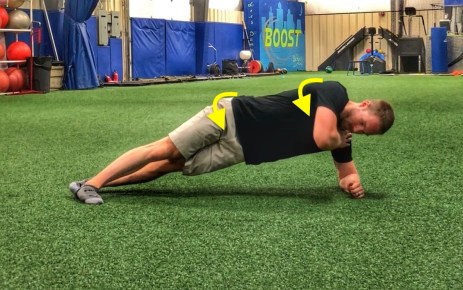
After addressing the anterior core muscles, let’s now move to the sides of the body. The side plank is a unique exercise as it activates the lateral oblique and QL muscles on only one side of the body, making it an excellent choice for addressing weak links in stability while placing minimal forces on the spine. It also engages an important stabilizer of the hip/pelvis on the lateral hip (the glute medius).12
Step 1:Lie on your side with your legs bent and upper body supported through your elbow. Place your free hand on your opposite shoulder.
Step 2: Raise your hips so that only your knee and arm support your bodyweight.

Step 3: Hold this position for 10 seconds before returning back down. Perform the same descending pyramid rep-scheme for each side.
There are a number of fun progressions you can do with this exercise. You can start by moving your hand placement from your opposite shoulder to the top of your hips or even move to a full side plank (bodyweight supported by your feet and elbow).
Perform the full side plank with one foot directly in front of the other, because you can also take it one step further and incorporate a rolling pattern (where you would tilt or rotate your body towards the ground and back towards the ceiling) if the side plank alone is easy. Make sure to keep your shoulders, torso and upper leg in a direct line during this roll to keep the low back safe.
If you are unable to accomplish even the modified side plank (bridging from the knees) due to shoulder or arm pain, you can perform a side lying leg lift. Start by lying on your side, brace your core muscles appropriately and raise both legs off the floor together a few inches. Hold them for 8-10 seconds before relaxing down.

The Bird Dog
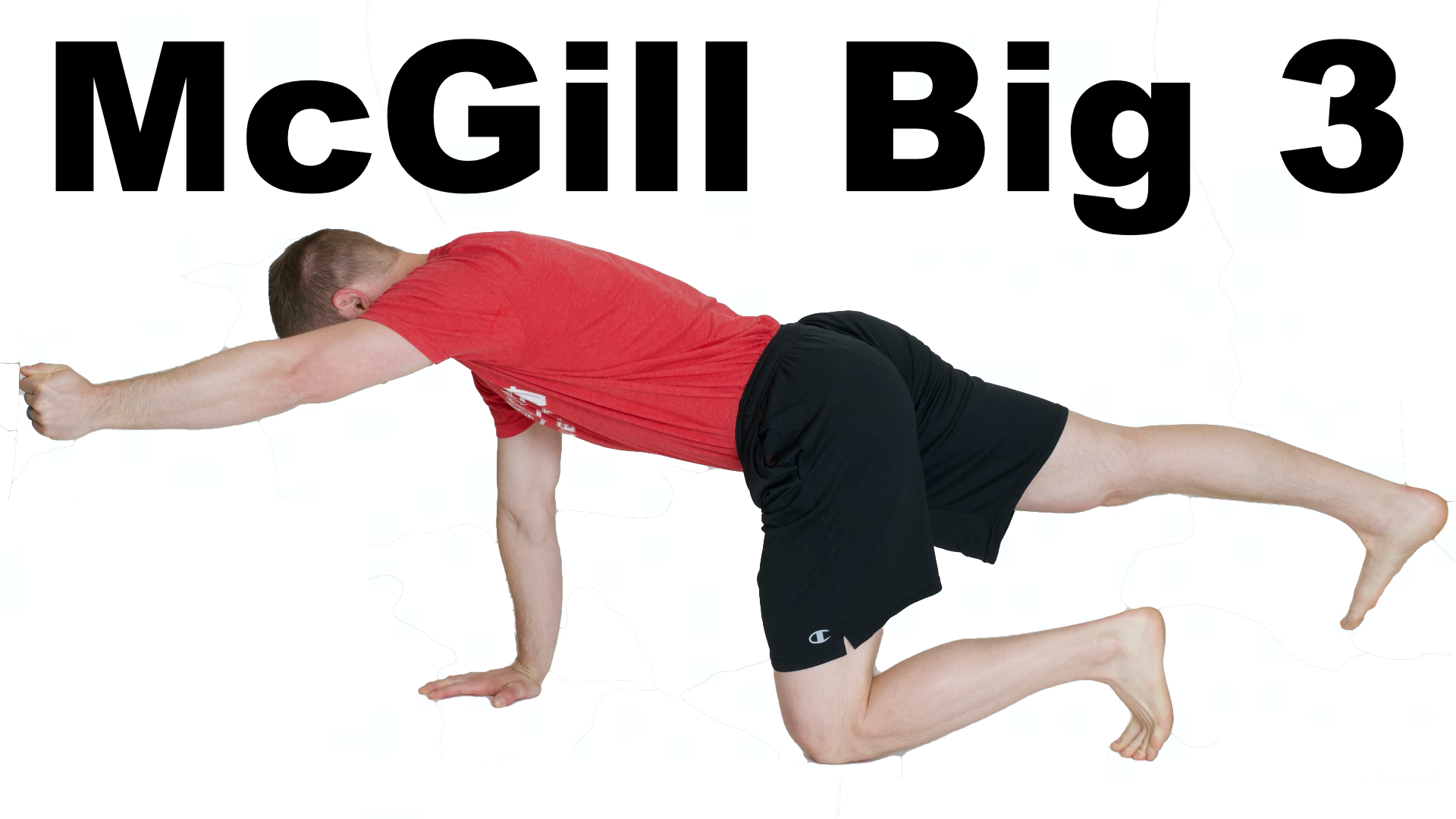
The last of the McGill ‘Big Three’ is the bird dog. This is an excellent exercise to promote a stable core while movement occurs at surrounding joints (either the legs or arms and legs together). The combination of movement occurring at the hips and shoulders while the low back remains stable allows this exercise to have excellent carry over to movements you perform throughout your day and in the weight room.
Step 1:Assume an ‘All 4’s’ position (quadruped) with your back in a neutral alignment. Remember a ‘neutral’ position is a very slight arch and not completely flat.
Step 2:Without allowing any movement to occur at the low back, kick one of your legs backwards while simultaneously raising the opposite side arm until both extremities are fully straightened. A helpful cue to make sure the leg movement doesn’t create an over-arching of your back is to think about kicking the heel of your foot straight back. Making a fist and contracting your arm muscles as you hold it in the extended position can also increase muscle activity of the core (especially of the erector spinae muscles).
If you are unable to perform the arm and leg movement together without pain or it is too difficult without losing balance, try the modified version with only leg movement.

Step 3:Hold each extended pose for 10 seconds before retuning back to the starting All 4’s position. You can also ‘sweep’ your arm and leg back underneath your body in between each repetition. Don’t let your back round during this motion but instead maintain the neutral spine position and allow the motion to only occur from the hips and shoulders! Again, perform the same descending rep-scheme as the previous two exercises.
You can progress this exercise by drawing a square with your outstretched hand alone or your hand and opposite foot together.
What About Low Back Stretching?
If you didn’t notice, the prior exercises to kick-start the rehabilitation process did not include any stretches for the back! Early in my career as a physical therapist, it was common to prescribe certain stretches (like pulling your knees to your chest while lying on your back) as an exercise for many with low back pain.
At the time this exercise made sense. Those who had difficulty standing for long periods or lying flat on their back often felt better when in a flexed position. Many who complained of feeling stiff and painful in their low back had instant relief of their symptoms after performing a few of these stretches.
However, I realized (after reading and studying from Dr. Stuart McGill) that this relief is only a temporary relief for most. When you stretch your low back, you are stimulating the stretch receptors deep inside the muscles that give the perception of pain relief and the feeling of less stiffness.
As I have written about in earlier blogs, most of the muscle pain and stiffness you may feel in your back is consequence of a chemical reaction called inflammation that occurs from the real injury located deeper in the spine (disc bulge, facet irritation, etc).5,6 The underlying injury is what causes the secondary contraction or spasm of the surrounding muscles and pain.
For this reason, rehabbing from a back injury for a large majority of athletes should aim to stabilize the core and reeducate proper movement to treat why the problem started rather than stretch the surrounding muscles to increase mobility of the low back and treat the symptoms.
Re-Awaken those Sleeping Glutes!
It is common to see athletes with back pain also have an inability to properly activate and coordinate their glute muscles. Simply put, the butt muscles can fall asleep.13When this happens the body naturally starts to use the hamstrings and low back muscles more to create hip extension (both are problematic in creating efficient movement and place excessive stress on the spine).1
If the single leg bridge test (from the prior blog on ‘Screening Low Back Pain’ exposed a problem in how your body coordinates and turns-on the glutes, the following exercises should help.
The Bridge
Step 1: Lie on your back with your knees bent as shown.
Step 2: Squeeze your butt muscles FIRST and THEN lift your hips from the ground. Picking your toes up and driving your heels into the ground can help increase your glute activation during this part of the movement. Squeeze your glutes as hard as you can in this bridge position for 5 full seconds before relaxing back to the ground. If you find your hamstrings cramp during this motion, bring your heels closer to your hips. This shortens the length of the hamstrings and gives puts them at a disadvantage to contribute to the movement (a concept called active insufficiency).14

Recommended sets/reps: 2 sets of 20 for a 5 second hold. Eventually work your way up to 10-second hold.
Deep Squat With Isometric Hold
Step 1: Hold a weight in front of your body and perform a deep goblet squat.
Step 2: Brace your core in this bottom position and drive your knees to the side while keeping your foot in an arched position (this should turn on the outside of your hips or glute medius muscle.)
Step 3: Rise a few inches and squeeze your glutes like crazy. Hold this for 5 seconds before sinking back down. This translates the glute activation from the previous exercise into something functional that mimics your squat technique. This should only be attempted if you can perform it without any back pain.
Recommended sets/reps: 1-2 sets of 5 for 5 second holds
Final Thoughts
I hope that this brief article was able to give you a better understanding of proper core stability training and how to perform the ‘Big 3.’ I recommend using these exercises not only as a foundation for your rehabilitation from back pain but also as a part of your weekly training program to prevent future injury once your symptoms have resolved.7
The combination of these exercises should be safely performed daily if you are trying to recover from back injury but should not be performed directly after rising from bed in the morning (that is the time at which the discs of your spine are most hydrated and prone to injury).11
The last thing Dr. McGill recommends to couple with the “Big 3” exercises is a regimented walking program.2 Getting up and walking throughout you day can be extremely helpful in maintaining the health of your spine. Start with smaller bouts of walking (5-10 minutes at first with a fast pace that causes you to swing your arms). The goal should be to eventually reach a 10-minute walk three times a day.2
If you continue to have back pain I suggest following the detailed program in Dr. McGill’s book ‘Back Mechanic.’ Then, when out of pain, shift to ‘Ultimate Back Fitness and Performance.’
Next week I will share a number of my favorite core progressions and corrective exercises you can use to continue enhancing your core stability and regain your previous performance.
Until then,

With

References
- McGill SM. Ultimate Back Fitness and Performance (4thed). Waterloo, Canada: Backfitpro Inc, 2009. (www.backfitpro.com)
- McGill, SM. Back Mechanic: The step by step McGill Method to fix back pain. Backfitpro Inc. 2015 (www.backfitpro.com)
- McGill SM. Core training: evidence translating to better performance and injury prevention. Strength and Conditioning Journal. 2010; 32(3): 33-46
- McGill SM. Grenier S, Bluhm M, Preuss R, et al. Previous history of LBP with work loss is related to lingering effects in biomechanical physiological, personal, and psychosocial characteristics. Ergonomics. 2003;46:731-746
- Indahl A, Kaigle A, Reikeras O, Holm S. Electromyographic response of the porcine multifidus musculature after nerve stimulation. Spine. 1995;20(24):2652-8
- Cohen SP & Raja SN. Pathogenesis, diagnosis, and treatment of lumbar zygapophysial (facet) joint pain. Anesthesiology. 2007;106:591-614
- Durall CJ, Udermann BE, Johansen DR, et al. The effect of preseason trunk muscle training of low back pain occurrence in women collegiate gymnastics. J Strength Cond Res. 2009;23:86-92
- Lee BC, McGill SM. Effect of long-term isometric training on core/torso stiffness. JSCR. 215;29(6):1515-1526
- Cholewicki J, McGill SM, and Norman RW. Lumbar spine loads during lifting of extremely heavy weights. Med Sci Sports Exerc. 1991;23:1179-1186
- McGill SM, Cholewicki J. Biomechanical basis for stability: an explanation to enhance clinical utility. JOSPT. 2001;31(2):96-100
- McGill SM. Stability: from biomechanical concept to chiropractic practice. J Can Chiropr Assoc. 1999;43(2)
- Boren K, Conrey C, Le Coguic, et al. Electromyographic analysis of gluteus medius and gluteus maximus during rehabilitation exericses. Int J Sports Phys Ther. 2011;6(3):206-223
- McGill SM. Low Back Disorders: Eevidence Based Prevention and Rehabilitation(2nd ed). Champaign, IL: Human Kinetics Publishers, 2007.
- Olfat M, Perry J, Hislop H. Relationship between wire EMG activity, muscle length, and torque of the hamstrings. Clin Biomec. 2002;17(8):569-579
- Grenier SG, McGill SM. Quantification of lumbar stability by using 2 different abdominal activation strategies. Arch Phys Rehabil. 2007;88(1):54-62
- Juker D, McGill SM, Kropf P, Steffen T. Quantitative intramuscular myoelectric activity of lumbar portions of psoas and the abdominal wall during a wide variety of tasks. Mec Sci Sports Exerc. 1998;30:301-310
- McGill SM. The mechanics of torso flexion: sit-ups and standing dynamic flexion maneuvers. Clinical Biomechanics. 1995;10:184-192

The McGill Big 3 for Core Stability are essential exercises to rebuild spine strength and resilience—key to recovering from low back pain and returning to barbell training. For more tips and free resources, visit our website and try the KissKH Asian iOS for free streaming—download now!
The McGill Big 3—curl-up, side plank, and bird-dog—are simple but powerful exercises that help build a strong and stable core. They’re great for anyone dealing with lower back pain or wanting to avoid it. These moves don’t just make your core stronger—they teach your body how to move the right way to protect your spine, especially if you want to get back to lifting weights safely. Dr. Stuart McGill’s methods have changed how people think about back recovery and strength. If you’re serious about keeping your back healthy for the long run, his work is definitely worth learning. I highly recommend checking out Jeinz macias an excellent companion tool website for staying informed on your journey.
Thanks for this informative post! As someone who writes about academic tools and study hacks, I found your content really helpful. I shared something similar recently that could add even more value for your audience. Appreciate your work https://cobaltt-tools.com/
hanks for this informative post! As someone who writes about academic tools and study hacks,
This breakdown of the McGill Big 3 is super helpful—I’ve read about these exercises before, but this post really clarifies *why* they’re so effective for core stability. I love how it emphasizes consistency over intensity, which honestly feels a lot like using a Rituals Adventskalender: it’s about those small, steady moments that add up to something meaningful. Do you incorporate these exercises into your regular routine, or are you just getting started with them?
This was such a solid breakdown of the McGill Big 3—I’ve tried them myself, and they truly do help build core stability without putting too much strain on the spine. It’s great how simple yet effective they are, especially for people who sit a lot or deal with back tension (guilty here!). Doing these exercises regularly feels a lot like opening the Rituals Adventskalender—small daily efforts that lead to a stronger, more balanced version of yourself. Have you noticed a difference in your posture or energy after adding these into your routine?
Discover how to set up your Canon printer quickly with ij.canon.start. This Canon site guides you through downloading the right drivers, installing software, and connecting your printer to Wi-Fi.
Great site! I always find the latest music updates on Jeinz Macias. Super helpful!
Explore More on Love Horoscope Today
https://lovehoroscope.today/
This was such an insightful read! The McGill Big 3 exercises really do offer a solid foundation for building core strength without overstraining the spine. I’ve tried the bird dog and the curl-up myself and noticed a big difference in posture and lower back comfort. It’s a great reminder of how consistency and proper technique matter more than intensity. Interestingly, just like how we build physical discipline through these core routines, maintaining regular **Namaz Timing in Karachi** offers a spiritual discipline that grounds the day. Have you incorporated these exercises into your daily routine yet—or do you have a favorite core workout?
Physical workout is best for staying healthy and fit.
Physical fitness is very important for us, i’m following your work guidelines
Regular physical exercise boosts health and fitness, and with Spotify Premium, you can enjoy ad-free music and motivation during every workout.
Amsha Advisory is a leading Top HR Consultancy Tanzania, offering tailored people solutions to enhance organizational performance. Our services include HR consultancy, entrepreneurial consulting, employee training & development, career development, upskilling & training, and talent assessment & selection. We utilize psychometric tools like Facet5 and MBTI to align individual strengths with business objectives. Committed to sustainable growth, we empower businesses to overcome HR challenges and foster positive workplace cultures. Partner with us to unlock your organization’s full potential and drive long-term success.
I found that breakdown of the McGill Big 3 really helpful—core stability often gets overlooked, but it makes such a huge difference for posture, injury prevention, and even everyday movements. I like how these exercises are simple yet so effective when done consistently. It actually reminded me of Estafas Bizum, where sticking to a few solid “core” habits—like double-checking details—can protect you in the long run. Do you usually incorporate stability exercises into your routine, or do you focus more on strength and cardio?
Looking for reliable Urbania rental in Kochi, Ernakulam? Parackal Travels offers well-maintained Urbania vans with professional drivers for group travel, airport transfers, tours, and more.
I thought your breakdown of the McGill Big 3 was really clear—it’s impressive how these simple exercises target stability and protect the spine without needing fancy equipment. I’ve found that consistency with moves like these makes a huge difference, especially if you sit a lot during the day. It actually reminded me of how, just like building a strong core, staying safe online with tools like Bizum also means having a solid “foundation” of habits to avoid *estafas Bizum*. Do you find these kinds of routines more effective when done daily in small sets, or in longer focused sessions a few times a week?
Going to Make Cool Text using That website for Free online works
Just wanted to say thanks for breaking this down so clearly! The curl-up, side plank, and bird-dog are deceptively simple but powerful. I love the idea of building a “stiff” core like an orchestra working together—such a great visual. I’m excited to start adding these into my routine and see the difference
The McGill Big 3 for core stability is such a practical and effective set of exercises—they focus on strengthening the core safely while improving overall posture and movement. It reminds me of watching football on **Futbol Libre TV**—you often see how a strong core and proper technique can completely change a player’s performance on the field. Do you think people stick to exercises more for long-term health or for immediate performance benefits?
MTMIS Punjab (Motor Transport Management Information System Punjab) is the official, secure, and fast-access platform for everything related to vehicle management across the province. MTMIS Punjab
Kepala Bergetar is my favorite site to watch all the latest Malaysian dramas online in HD. They update every episode on time, and the streaming is super fast. Highly recommend for drama lovers!
If you’re into Malay dramas, Kepala Bergetar is the go-to site. I always watch my favorite shows there—smooth streaming and latest updates daily.
Found my favorite drama on Basah Jeruk last night! Fast loading, no annoying ads, and full HD quality. A must-visit site for drama fans.
Compare updated solar panel prices in Pakistan. Find per-watt rates & total costs for Longi, JA, Jinko, Canadian & more top brands. Solar Panel Prices
Clear, practical advice that I can start applying to my training right away.
This stuff about core stability? Totally spot on. The muscles need to click together, just like in that manga where love is all about connection—check it out for more ideas! I Want to Love You
The point about spine stiffness is crucial. You gotta keep it stable, like dodging obstacles in a snow game. It all makes sense when you think about it. Snow Rider 3D
Great breakdown on muscle coordination. If they don’t sync, injuries happen, kinda like drama in a good yuri manhwa—always a twist! Don’t ignore that. Drunken My Boss
Isometric exercises are game changers. They work wonders for spinal stability, just like a guide helps you ace a dating sim! Keep it in mind. Date Everything Guide
Very useful exercises for core strength. The explanations are clear and easy to follow. https://sites.google.com/view/daniel-dantas
An informative and well-explained overview of the McGill Big 3 exercises. The emphasis on controlled movements, breathing, and spinal protection provides valuable guidance for anyone looking to build a resilient and stable core safely.
This post brilliantly breaks down the McGill Big 3—curl-up, side-plank, and bird-dog—into clear, actionable steps for core stability and injury resilience; thanks for such a valuable, well-explained guide! https://www.facebook.com/sidneydequeirozpedrosa/
good blog post please keep posting, love from https://treasurenft.life/
This was a great post. I liked your ideas and can’t wait to read more from you. love from
https://viduapk.com/
This exercise is very important and mandatory for us. Thanks to remind us for our health. CapCut Pro APK
he proposed intervention will include clear objectives, defined timelines, adequate resource allocation, and evidence-based practices to support effective execution. Additionally, the plan will remain consistent with organizational priorities and uphold professional nursing standards.”
Watch All new upcoming movie Online freeNetmirror app
Portillo’s menu offers a delightful array of Chicago-style classics, including Italian beef sandwiches, Chicago-style hot dogs, and char-grilled burgers, all served with their signature crinkle-cut fries.
Wingstop has become a prominent chicken wing chain in the United States, with over 2,250 locations across 47 states and territories as of early 2025 . The highest concentration of Wingstop near me is in Texas, boasting 461 locations, followed by California with 421, and Florida with 144
The McGill Big 3 is such a practical approach to building core stability—I like how it focuses on controlled, safe movements rather than flashy exercises that can strain the back. I’ve tried the bird dog and curl-up before, and they really do help with posture and overall strength if you stick with them. It kind of feels like preparing for Black Friday Tarjouskey—you need a solid foundation and strategy to avoid unnecessary strain and get the best results. Have you noticed more benefit from doing these daily, or a few times a week?
Surah Yaseen holds immense spiritual value, often called the heart of the Quran. Reciting it brings peace, guidance, and blessings. For learners seeking deeper understanding, tafseer surah yaseen in urdu pdf provides clear explanations, helping readers connect with its message and gain wisdom through simplified interpretations and translations.
Surah Yaseen holds immense spiritual value, often called the heart of the Quran. Reciting it brings peace, guidance, and blessings. For learners seeking deeper understanding, tafseer surah yaseen in urdu pdf provides clear explanations, helping readers connect with its message and gain wisdom through simplified interpretations and translations.
I’ve tried the McGill Big 3 for core stability, and I have to say they really make a difference. I like how simple the moves are, yet I can feel my core working in a controlled way without straining my back. For me, it’s a solid routine I can stick to long-term.
For the modified curlup, you are incorrectly only lifting the head. McGill in The Back Mechanic specifically says to lift the head and AND shoulders. Please fix! Here is Mcgill himself demonstrating this https://www.youtube.com/shorts/uzMYRO05kJw
The McGill Big 3 are such a smart approach to core stability—I like how they focus on building strength without putting too much stress on the spine. It’s the kind of routine that feels doable and really pays off in posture, movement, and even reducing back pain over time. Honestly, it makes me think about balance the same way the DQ Blizzard Menu balances classic flavors with fun new twists—keeping a strong foundation but still making things enjoyable. Do you usually stick to structured exercises like these, or do you prefer more dynamic workouts?
Rogzov application offers quick access to a large catalog of movies and TV shows, appealing to viewers who value convenience and variety.
This exercise is very unique and good. My gaming experience has improved a lot since HappyMod provides unlimited access to premium apps without paying anything.
Rogzov attracts attention for bringing together both international blockbusters and regional productions in one place.
This was such a helpful read. I’ve struggled with low back pain before, and it’s great to see exercises explained in a way that feels approachable and safe. I like how the article highlights the importance of stability over flashy movements, because that’s something I’ve overlooked in the past. It made me think about how small, consistent habits can make a big difference over time. In a totally different context, I get a similar reminder of patience and timing when I play casual games over at taptapshots.net.
PM Vishwakarma Yojana Portal is available only for Online users. Apply for PM Vishwakarma Scheme 2025, Check Eligibility, List, and Check Benefits. Also, Check Beneficiary details, status, and Yojana details. PM Vishwakarma
These excercises improve our health and keep us motivated.