
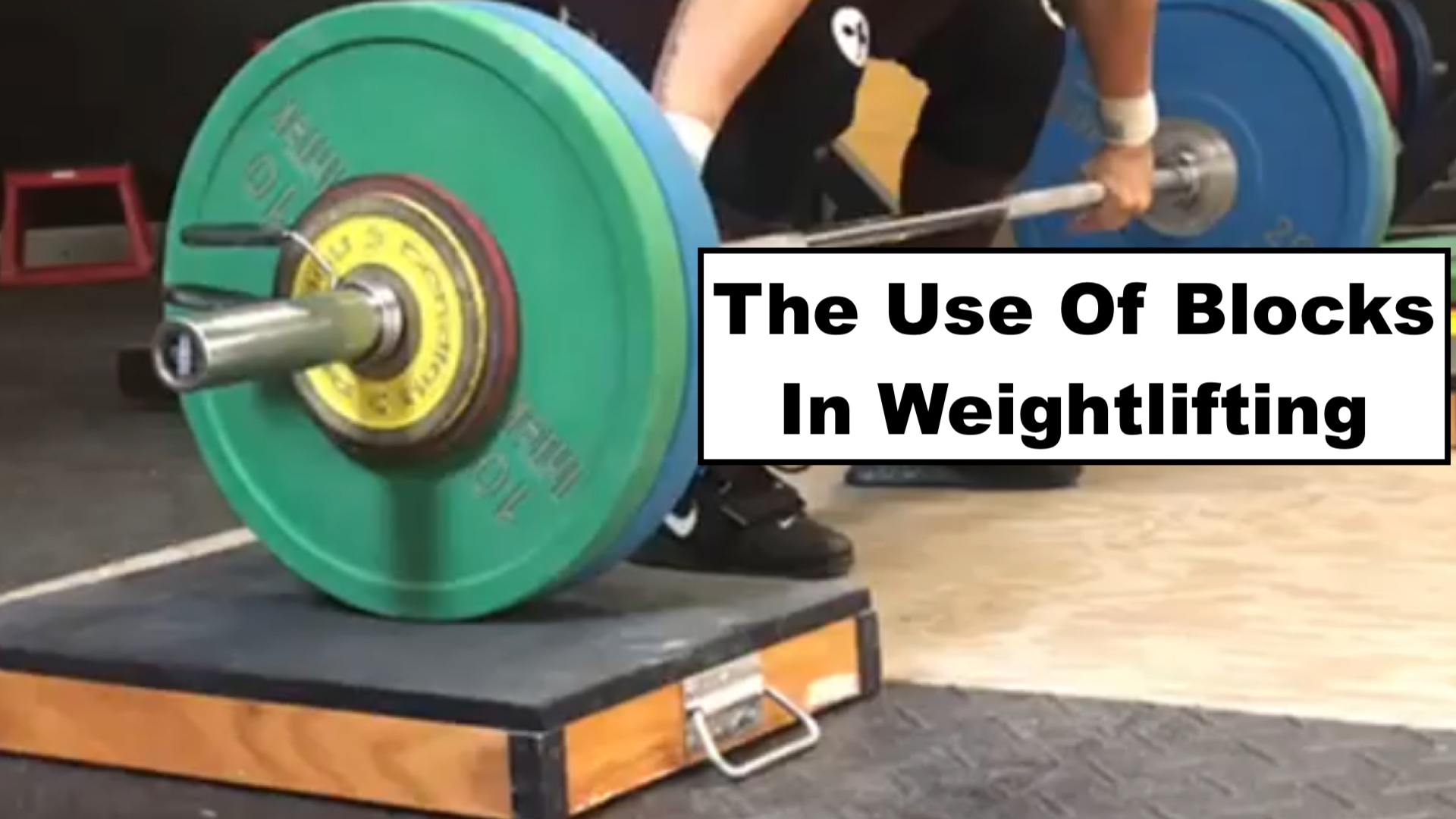
When Dr. Aaron Horschig, aka Squat University, asked me to collaborate with him on the topic of “why a weightlifter would want to lift from blocks”, I was incredibly excited. Dr. Horschig is doing an incredible job informing and educating the public regarding the barbell movements. My entire life has been spent competing, coaching, and educating others about the barbell and strength in general. Of course I am going to help anyone that is trying to help with the cause especially someone that is crushing it like Dr. Horschig with his ‘Squat University’ channel. He has to be the fastest growing social media presence of anyone in the barbell world.
We use blocks at the Mash Compound rather frequently. We use blocks for three main reasons:
- Target specific aspects of the pull that individuals might be struggling.
- Max Effort and Overload for the lifts
- Easier to recover from
Specific Heights
We use three main heights: high blocks with the bar near the hip during the power position, medium blocks with the bar at the knee, and low blocks 4-6 inches high. Of course you can use any height that targets a specific weakness of the pull that an individual might be experiencing.
High Blocks
We use high blocks to teach athletes timing and speed under the bar. Most athletes and coaches focus on the pull from the ground to triple joint extension, and this is definitely a part of the equation. However, the timing between the second pull (the part of the pull where the torso moves to vertical and extends at the top) and the third pull (the pull under the bar) along with the speed under the bar is the differentiator between a good weightlifter and a great weightlifter.

High Blocks from the power position eliminates any momentum that might be formed during the pull from the floor. The athlete powerfully extends at the hips and knees, and then they are forced to rip under the bar if a good lift is to be achieved. If they waste any time at the top of the lift, they will miss the peak of the barbell and risk getting beat to the catch position by the falling barbell. Once the hips and knees extend, the trajectory of the barbell is determined. Any extra effort to increase the height of the barbell is wasted effort that could be spent getting under the barbell. Some of our best athletes are incredible strong from this position, which we will talk more about later in this article.
High blocks are also great for teaching that athlete exactly where the body should be during the power position, which is knees bent 4-6 inches, shoulders on top of the bar, torso almost vertical, long arms with elbow turned out, and eyes straight ahead. This block height is invaluable for teaching new lifters proper position, timing and speed under the bar. It’s great for advanced athletes as a variation, overcoming weaknesses, and a max effort movement.
Medium Blocks
This height is great for teaching athletes where they should be in position 2 of the pull with the bar around knee height. Let’s explain this position first. At this point of the lift, the shins have moved closer to vertical as the knees have cleared the road for the barbell, the shoulders are in front of the barbell, spine is neutral, shoulders are still clearly above the hips, eyes forwards, and arms are long with elbows turned out. Turning the elbows out is important for the trajectory of the barbell. With the elbows turned out, the barbell will stay closer to the body versus traveling out and away from the body.
We use this height primarily to teach this position. Some common errors during the pull are getting the shoulders behind the bar too soon (causing the bar to swing away from the body during contact), letting the hips shoot up (causing the bar drift in front of the body), and swinging the barbell around the knees leaving it in front of the body. The goal here is to teach the athlete where they should be, and therefore, creating a better neurological pattern. Basically you are teaching the brain where it should be during this phase of the pull, so the brain does it automatically.
Low Blocks
Most lifts are made or missed right off the floor. The most common mistake in weightlifting is yanking the barbell off the floor, hips flying up in the air, and causing the barbell to drift from the body. During the first few inches of the pull, it’s important to drive the feet through the floor, sweep the bar in towards the body, begin moving the knees out of the way of the barbell causing the shins to begin moving towards vertical, shoulders are kept well above the hips, and the shoulders slightly in front of the barbell.

Perfecting these first few inches is the most important aspect of the first pull. If the barbell starts out correctly, it sets up the second and third pull to be completed more efficiently. The blocks once again help to teach the athlete the position that they should be in during this aspect of the pull. Blocks allow the coaches to perfect the position of the athlete in relation to the barbell before any pressure is applied to the ground. Early in a lifter’s career, it is crucial to perfect these positions, and blocks are a great tool to perfect the position of the body during the separate phases of the pull.
Max Effort and Overload Work
We might not train exactly the way that Louie Simmons would prescribe, but we sure use a lot of his principles. Maximum Effort Method is a fancy term for going heavy. You can’t get good at lifting heavy weights by only lifting light ones. It’s common knowledge that the best way to add kilos to the barbell is by lifting at 90% and above. The key question is how often and at what volume.
The problem with constantly snatching and clean & jerking from the floor to a maximum is the risk of injury and the law of accommodation. Basically the body will get used to the movements and stop adapting, and then the almighty plateau sets in. We go heavy once or twice per week with Fridays being our constant max effort day. If you come to our gym on a Friday, we will be maxing out in some fashion. By using variation, we can avoid the dreaded accommodation.
Blocks are one of those variations that we love. We use them in two ways on max effort day. First, me might choose the athletes weakest portion of the pull to target. This will help to improve the athlete at that section of the pull, and it will help to minimize the load. Max Effort doesn’t always mean going to 100% of the Snatch or Clean & Jerk. I can use complexes or in this case blocks to minimize the load and still practice applying maximum effort. The athlete still learns to perform with maximum loads, but the body is spared higher overall intensities.
Some athletes are exceptionally strong at specific block heights. Nathan Damron is incredible strong at high blocks. Therefore, we use high blocks to begin the process of him lifting heavier weights. For example, he snatched 160kg from high blocks and month before he snatched it from the floor. When he Snatched 160kg from high blocks, his best from the floor was 155kg. The blocks helped him gain confidence in the lift, and started the adaptation of the body required to lift those heavy weights. We call this the overload principle. Powerlifters use this all the time with their board presses and use of the slingshot.
Recovery Purposes
We use blocks a lot on Wednesday to give the body a bit of a break from full range of motion pulling. We have found that it allows our backs especially to heal up before Max Effort days on Friday. Right now, almost everyone in our gym is on competition preparation programs. Most of them are 1-5 weeks out from competition, so we use the short blocks to mimic the lifts as closely as possible for specificity reasons. This gives us just enough of a break to perform at near maximal levels on Max Out Friday without throwing off the perfection in the lifter’s timing required for all-time bests.
Final Thoughts
I hope this short article helps to explain some ways that we use blocks in the training of our athletes. There is a time and place for just about every principle or method, but the key is understanding the use of each. Now you will have some ideas where to use blocks in the training of your athletes or yourself. For more information on just about anything barbell, you can check out www.mashelite.com for thousands of articles, hundreds of podcasts, and several free programs to tryout. Yes this is my plug! I hope you enjoyed the article.
 Travis Mash was a World Champion in powerlifting. He competed in a world-class level in Olympic weightlifting. He has coached professional Olympic weightlifters alongside Don McCauley and Glenn Pendlay at Team MDUSA and now coaches Mash Elite Strength weightlifting team.

Such as a very helpful and knowledgeable article
My favorite article is “The Real Science of The Squat”. Your articles are nice to read. can you write my paper for me cheap? Just contact me by mail.
A very interesting article, especially for me as a writer.
You dont seem to mention the fact that some people have shorter legs than torso. For these (like myself) lifting from blocks gives a more natural starting position, similar to long legged people.
Hi! Thank you for this article!
[…] an Olympic clean […]
Looking for trustworthy essay assistance. Thoughts on assignmenthelp4me.com, anyone?
https://scamfighter.net/review/assignmenthelp4me.com
Your blogs are great.Are you also searching for Jean Watsons Theory of human caring? we are the best solution for you. We are best known for delivering nursing writing services to students without having to break the bank.whatsapp us:+1-(951)-468-9855
I want to always read your blogs. I love them Are you also searching for Nursing personal essay help? we are the best solution for you. We are best solution for you.
Exercising helps increase getting over it health and reduce the risk of health problems.
Gameplay Mechanism:
suika game is a puzzle game that focuses on stacking various fruits into a box in a flexible manner.
Players need to combine two identical fruits to create a new one with a higher score.
This article is very nice and helpful, I like it very much, thanks for sharing this. You can also play new games in Tiny Fishing
Anchor Text
Prestige Siddharth Vihar in Ghaziabad offers contemporary residential living with a focus on comfort and style. Located in a prime area, it provides easy access to essential amenities and excellent connectivity. The project promises modern architecture, spacious apartments, and a range of facilities designed to enhance the quality of life for residents.
International students’ academic paper assignment ghostwriting services not only offer high-quality academic papers but also provide various other forms of academic support. They can offer relevant academic resources and references based on students’ needs, helping them better grasp academic theories and methodologies during the writing process. Additionally, ghostwriting https://www.yydaixie.com/ services provide paper editing and proofreading services to enhance the quality and language expression of students’ papers. For urgent situations, these services can also offer fast academic paper ghostwriting services, ensuring that students can submit their papers on time.
I have discovered a fantastic and incredible new hobby and it is Chernobyl city, which in its time has gone through many troubles, and now I am very interested to learn information about it myself is chernobyl still radioactive , I want to get there, here is the Chernobyl vehicles graveyard, I read an interesting satnav dedicated to cemeteries!
snow rider features no two races that are exactly the same. The landscape is chaotic and erratic, hence slow reactions have no place! On uneven, dangerous routes, do you have the lightning-fast reflexes required to avoid a bombardment of obstacles?
Weightlifting is an excellent way to build strength and stay fit, and using blocks can enhance your routine by improving technique, targeting specific movements, and reducing strain on the body. Incorporating blocks allows you to focus on your form and gradually increase your lifting capacity, making them suitable for beginners and advanced lifters alike. However, fitness is not complete without proper nutrition. A balanced diet rich in protein, healthy fats, and carbohydrates is essential for muscle recovery, increased energy, and overall well-being. Pairing weightlifting with nutritious meals, such as those available on the Greggs menu, can help you achieve better results by fueling your workouts and promoting faster recovery. By combining the right tools and diet, you can transform your fitness journey and enjoy a healthier, more energized lifestyle.
Fascinating read on using blocks for weightlifting — I can see how they’d really help with form and power! On a different note, I’ve been exploring ways to boost online visibility for my business, and I found https://www.seoforcontractors.us/seo-services-for-california-general-contractors, which has some great SEO tips for California-based pros. Might be useful for fitness coaches looking to grow their reach too. Anyone else tried blocks in their training?
This article on using blocks for weightlifting is super informative — I can see how they’d really help with technique and power! On a side note, I often research training tips online, and I found a popup blocker that’s been a lifesaver for browsing without distractions. It might be useful for others here who are looking up weightlifting resources. Have you tried using blocks for other lifts besides the ones mentioned?
Ultimately, schoolboy runaway is not just a game; it is an experience filled with adventure, laughter, and life lessons. This game captures the essence of youthful rebellion and freedom, inviting players of all ages to join in on a hilariously fun quest for escape and discovery.
https://curverushgame.net/
Curve Rush blends quick thinking and sharp turns into one electrifying online experience.
What started as just a casual hobby quickly evolved into a rewarding journey toward consistent earnings with https://linebets-arab.com/app/. At first, I was simply exploring sports betting out of curiosity, but Linebet’s intuitive platform, reliable odds, and impressive bonus offers gave me the motivation to dive deeper. Over time, I developed my own strategy, learned how to manage risks, and started seeing real profits. What truly sets Linebet apart is how it supports beginners while offering tools for experienced players to grow. It’s not just a betting site — it’s a platform that helped transform my interest in sports into a steady stream of income.
This is a great insight into the specific benefits of using blocks for weightlifting, especially for targeting different parts of the pull and improving speed. It’s interesting how different block heights can address various technical aspects of the lifts. For those in the UK facing the complexities of academic research, dissertation proposal writers in UK can offer expert assistance in structuring your ideas and crafting a compelling proposal to support your scholarly “lifts.”
Excellent insights on core stability and its real-world importance—not just in athletic performance, but in day-to-day living too. At Apartment Renovation Dubai (ARD), we often work with clients who are recovering from injuries or looking to create homes that support healthier, more functional lifestyles. Whether it’s installing ergonomic flooring, optimizing spatial layout, or integrating supportive design features, we understand how the built environment affects well-being.
If you’re considering renovating your space for comfort, style, or wellness, feel free to learn more about what we do. We’d be happy to help you reimagine your space.
If you’re looking for a reliable way to uninstall Total Adblock, this article on total adblock remove provides clear, step-by-step instructions. It helps you safely remove the extension and resolve any related issues, ensuring your browser stays fast and free from unwanted software.
Maintaining a clean and professional workspace is crucial for any business. Allora Cleaning offers reliable janitorial services sacramento companies can depend on to keep their offices and facilities spotless. Their skilled team provides customized cleaning plans that ensure high standards of hygiene and presentation, helping businesses create a welcoming environment for employees and clients alike.
Successful project management starts with clear and thorough business analysis. If you want to understand how professional business analysis can drive your project’s success and align your goals with actionable plans, so here is a great example of a service that offers detailed business analysis to help businesses identify needs, risks, and opportunities. This service ensures your project is well-planned and efficiently managed from start to finish.
From exclusive highlights to in-your-face confidence, Baddies East is the hotspot for everything bold, viral, and unstoppable.
Great article! I’ve always found block work in weightlifting to be incredibly useful for technique refinement and injury prevention. On a related note, for those looking to unwind after training, you might enjoy exploring Freecine apk — it’s a great streaming app for free movies and shows. Worth checking out! https://appfreecine.com/
[…] Squat University: Using Blocks for Weightlifting […]
Thanks! It helps a lot. I’m working hard on myself and chasing true love. If you’re also curious about how compatible you are with your crush, check this out!
https://lovehoroscope.today/love-calculator
Great breakdown of how blocks improve both technique and strength! I love the focus on targeting specific phases of the lift for better performance.
Tired of grinding? Dominate Hunty Zombie with our Auto Farm & Auto Attack Script!
Get the ultimate advantage now at https://www.scripthuntyzombie.com
Discover the future of expression with **2K26 Zen Script**. Explore more at https://www.2k26zenscript.com
This collaboration sounds amazing! Blocks are so crucial for targeting specific parts of the lift. Getting those angles just right is key for technique. Sometimes I even use an online protractor to check my positioning. Excited to read more!
Using blocks in weightlifting helps improve form, strength, and lift consistency — just like Nekopoi apk enhances smooth performance.for more visit this site https://nekopoiapks.com/
Awesome post! Thanks for this. Clean Water
Love this site! 3 Patti Lucky always keeps the fun going. It’s easy to play, and I’ve even invited my friends to join — we all enjoy it together!
Join 3 Patti Lucky official site
“Just discovered Parke Shops absolutely loving their streetwear collection! The designs are clean, the fabrics feel premium, and the vibe is super modern. Can’t wait to build out my wardrobe with their new drops! Parke Official
Great insights on using blocks for weightlifting! It reminds me how small tweaks can make a big difference, like how a Free Favicon Generator Online helps polish a website’s look effortlessly. Thanks for sharing!
Really enjoyed your breakdown of how blocks can help improve lifting technique and target specific parts of the pull it makes the whole weightlifting process feel more intentional and precise. Seeing how different block heights can refine positions and build confidence in lifts was especially insightful! Also, I couldn’t help but think how even training blogs can be a cozy break from holiday hustle maybe while wearing my A Merry Little Ex‑Mas 2025 Alicia Silverstone Knitted Sweater!
The ritual roots of performing arts cannot be ignored. Ancient ceremonies of song, dance, and storytelling evolved into today’s theater and concerts. Performing arts still carry that sense of sacredness, connecting us to traditions where art was more than entertainment—it was spiritual expression and community bonding. http://www.socialprofitstrategies.net
“Parke Shops’u yeni keşfettim ve sokak giyim koleksiyonuna bayıldım! Tasarımlar sade https://www.bakirkoyevdeneve.com.tr/
Interesting post! Using blocks can really help improve lifting form and reduce injury risk. For anyone curious about legal procedures related to disputes or claims, resources like Miami Dade Disputes can provide helpful guidance and documentation. It’s always good to stay informed both in fitness and in legal matters. Thanks for sharing these tips!
Great insights on using blocks to improve lifting form! I’ve found that keeping track of your equipment and progress can make a big difference, and resources like Sumter land records can help with organized tracking. Consistency and proper technique really boost results, and having the right tools at hand makes the process much smoother.
Great explanation about using blocks for targeting weaknesses in the pull. I like how you broke down the different block heights and their purpose in improving timing and speed under the bar. While reading about training and performance topics, I often explore different public information resources too, and I recently came across some useful data related to Lake County Records that people might find informative when looking into official records. Overall, this was a really insightful post on weightlifting technique and coaching strategy.
Great breakdown of how blocks can be used to target specific phases of the pull. I’ve noticed that many lifters underestimate how much improving the transition and timing can impact overall performance. The explanation about different block heights and their purpose makes it much easier to understand how coaches structure training. While researching training resources and background information recently, I also came across Court Records Search which had organized public information that was surprisingly useful for general research. Really appreciate the practical insights shared in this post—very helpful for athletes trying to refine their technique.
Really insightful breakdown on how lifting from blocks can target specific phases of the pull. I’ve noticed that focusing on different heights definitely helps athletes understand timing and positioning better, especially around the second and third pull transitions. Interestingly, when organizing group fitness challenges during the holidays, I came across an Online Gift Exchange tool that helped manage participant pairings smoothly. It reminded me how structured systems—whether in training or organizing events—can make things much more efficient. Great post and thanks for sharing these coaching insights!