
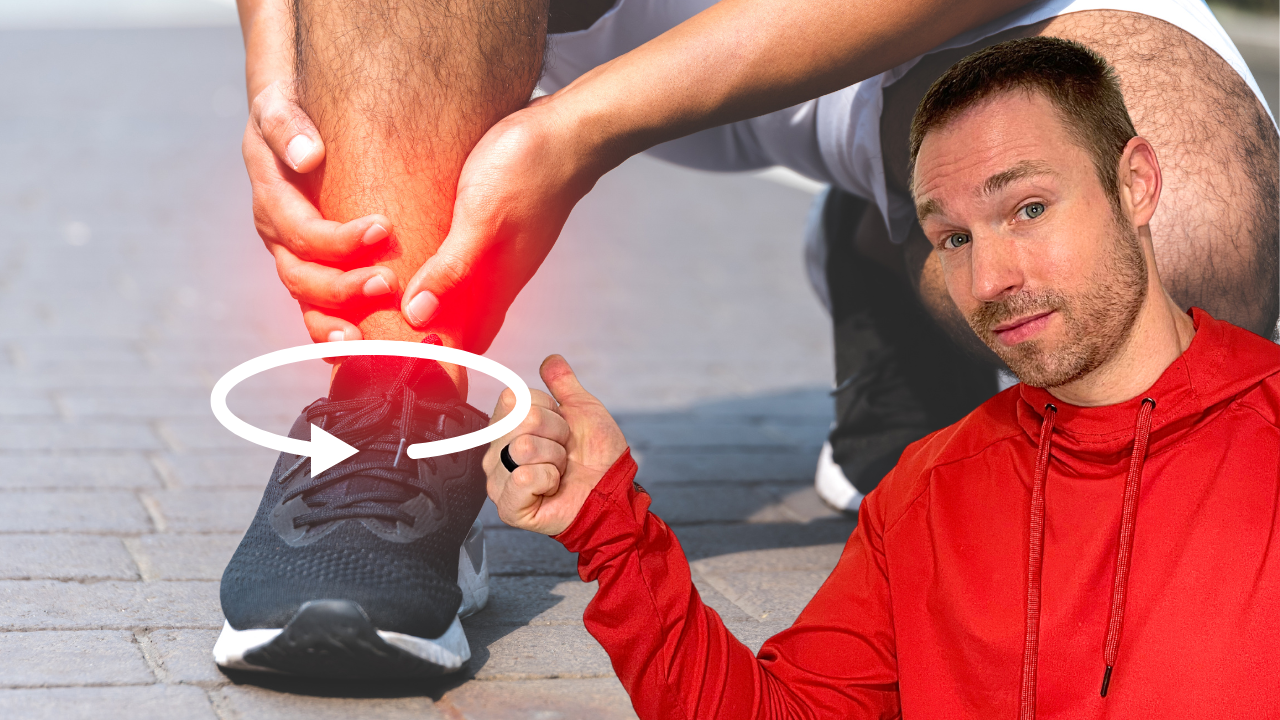
When assessing and fixing the cause of knee pain, there is one factor that many completely miss. The motion of tibial rotation. Let me explain.
You see, as you descend into a squat your knee moves towards and (in some people) eventually over the toes. This motion comes from the ankle joint (called dorsiflexion). Restrictions in ankle mobility halt forward knee travel and limit squat depth. Doing so in many cases causes the knee joint to take on more load more quickly, increasing risk of injury.

While improving ankle dorsiflexion is a helpful solution for increasing squat depth and resolving knee pain for some individuals, it’s not the only factor to consider!
The joints of the body do not only open and close in a 2-dimensional plane of motion like we observe when we assess the squat from a side view (called the “sagittal plane” of motion). In fact, there is rotation of the legs (through the “transverse plane”) and also motion occurring side-to-side (through the “frontal plane”).
For example, during the squat motion the knees begin in a straight “extended” position in standing and begin to move forward or “flex” as you descend. At the same time, they also rotate opposite each other in a twisting manner (the femur is externally rotating while the tibia is internally rotating in a process called the “screw-home mechanism).
This same complex set of movements also occurs at the ankle joint. As the knee moves forward, the tibia continues to internally rotate (remember it does the opposite motion of the femur as you descend into a squat) but also tilts to the side. This motion is called lateral tibial glide and takes places between the tibia and the top of the foot.
Sufficient tibial rotation and lateral glide at the ankle allows the knee to assume a more stable and stacked position (in relation to the hips and feet) when performing a squat or lunge movement. These two small yet important joint motions (called “accessory movements”) allow for the knees to track over the toes in the most optimal manner under load.

Squat Descent Sequence Motions:
- Hips:
- Sagittal Plane: femur moves back in a hinge motion
- Frontal Plane: femur open to the side
- Transverse: femur externally rotate
- Knees:
- Sagittal Plane: move forward over toes
- Frontal Plane: open to side
- Transverse plane: twist-like motion of opposite tibia/femur motions
- Ankles:
- Sagittal Plane: tibia moves forward over foot
- Frontal Plane: tibia tilts to the side
- Transverse plane: tibia internally rotates
These movements described above are “linked,” meaning that a restriction or problem motion in one joint can have a consequence in a completely different joint. For example, limited ankle dorsiflexion can lead to a change in mechanics at the knee joint (contributing to movement compensations in the frontal and transverse planes of the knee and hip leading to “knee valgus” collapse).1
Also, if a joint has a movement problem in one plane of motion, it can hinder optimal movement in other planes of motion at that same joint. For example, someone who lacks dorsiflexion ankle mobility may also often have limited tibial rotation and lateral glide.2 In this case, it’s not always possible to tell which problem started first (a classic “chicken or the egg conundrum”) so both need to be assessed and addressed to ensure we don’t’ leave any stones unturned.
Screening
Tibial Internal Rotation Assessment
Start in a seated position with your feet straight forward. Grab your thigh and don’t let it move at all as you rotate your toes in towards the mid-line of your body. Don’t allow your big toe to rise from the floor! Allowing your foot to roll on its side (excessive supination) as you slide your toes in can give you a false impression of how much rotation is taking place at the tibia. Hold this end position and then perform the same movement with your other foot.

What did you find?
Research and current expert opinions believe that most people should be able to show anywhere from 12-20 degrees of motion with this test.3-5 However, what we are most concerned with is big side to side differences. If you found a significant limitation on one side, your next step will be to try the banded rotation drill described below.
Lateral Tibial Glide Assessment
Another often overlooked joint motion that is directly tied to rotation of the shin (and therefore the positioning of the leg during lifts like the squat or deadlift) is lateral tibial glide. As you descend into a deep squat, the tibia bone not only internally rotates but also glides laterally over the talus bone of the foot so that the knee can move directly over your toes and stay in proper alignment with the rest of the leg. Here’s a simple way to assess this motion.
Step onto a box that is around knee height or drop into a lunge position. Your toes should be pointed straight forward and your shin at least slightly forward of vertical. Grab your front foot with both hands and push the inside arch toward the ground slightly (the act of pronation). Don’t let your foot move as you then open your hip and drive your knee out to the side as far as you can by squeezing your glutes. Perform this drill on each side and compare the angle your shin assumes in the lunge position. If there is a significant limitation on one side, your next step will be the tibial glide self-mobilization.
Corrective Exercise
Banded Tibial Rotation Drill
Assume a lunge position with your back leg resting on the ground. Place a band underneath the base of your big toe on your forward leg. Grip the ground and establish a stable foot to trap the band against the floor. Next, tension the band by pulling it away from your body as you simultaneously open your knee to the side by squeezing your glute. Try to open your hip as far as possible without your foot rolling on its side and allowing the band to snap out from underneath. Hold this position for five seconds before relaxing back to the start position and removing the band tension.
Start with 10 reps for a 5 second hold. If you’re performing this exercise correctly you will feel your glutes working hard. Then make sure to immediately retest your tibial rotation screen to see if you were able to see any changes in mobility.
It’s important to ensure sufficient glute activation during this drill because one hypothesis for decreased tibial rotation is the glute medius is actually weak or inhibited. If this muscle is not engaging optimally it can lead to an over reliance on the nearby TFL muscle and cause increased tension in the IT band (which can limit tibial internal rotation).
Tibial Glide Self-Mobilization
Assume the same lunge position as the prior test (foot elevated onto a box around knee height or in a kneeling position on the ground). Perform the same motion as per the test by holding your foot down and driving your knee out to the side. You can even give yourself a little assistance with your arm but don’t let your foot roll on its side.
Hold this end position for 5 seconds and perform 10 repetitions. Over time work into setting up with more ankle dorsiflexion (shin angled further forward by driving the knee forward first). You can also position your foot angled slightly inwards (more tibial internal rotation). Then complete the lateral tibial glide movement.

Banded Joint Mobilization
Some, but not all, who present with a restriction in tibial rotation and/or lateral tibial glide also have limitations in knee over toe movement at the ankle (dorsiflexion). If you find with testing that you have a significant difference in your problem ankle compared to the other side, be sure to combine the prior drills with a banded joint mobilization.
Banded Squats
Once you have completed the prior steps to address the movement restrictions at the ankle, we must then take a step back and address full body movement. The squat with a band around the lower shins is an excellent way to do this. While a resistance band loop around the knees is not wrong, placing a band around the lower shins draws attention to the action of the foot and tibia during the squatting motion.
Start by assuming your normal squat stance. If you have chosen the correct size/resistance band loop you will not have any difficulty getting into this position (whereas using a banded loop that is too tight/strong will limit proper stance width). Next, root your foot to the ground by pushing your big toe down as you open your lower body to tension the band. This simultaneous action creates the desired external rotation torque at the hips that must be maintained during the rest of the squat.
Then, perform a few reps by lowering under control for 10 seconds with a 10 second pause in the bottom position. Focus on maintaining the stable tripod foot structure the entire movement and constant outward tension against the band.
When you return to loaded squats, use this banded set up during your first few warm-up sets. One recommended variation is to perform your first rep of any warm-up set with a 5 second descent and 5 second pause at the bottom. Follow this slow rep with as many regular tempo reps as required by your program. This method will help you prime the desired movement pattern and help you feel more comfortable in the bottom position of your squat (where the mobility demand is the highest).
Conclusion
I hope this blog allows you to have a better understanding of an often under looked aspect of the ankle. Restoring proper tibial glide and tibial rotation can create a positive effect in your lifts while also reducing injury risk.

Until next time,


References
References
- Bell-Jenje T, Olivier B, Wood W, Rogers S, Green A, McKinon W. The association between loss of ankle dorsiflexion range of movement, and hip adduction and internal rotation during a step down test. Man Ther. 2016 Feb;21:256-61.
- McClay IS, & Manal K. Coupling Parameters in Runners With Normal and Excessive Pronation. Journal of Applied Biomechanics, 1997;13, 109-124.
- Stanek J, Parish J, Rainville R, Williams J. Test-retest and intra-rater reliability of assessing tibial rotation range of motion by two devices. Int J Athl Ther Train. 2000;25:263-269
- Stanek JM, Brown B, Barrack J, Parish J. A novel manual therapy technique is effective for short-term increases in tibial internal rotation range of motion. J Exerc Rehabil. 2021 Jun 30;17(3):184-191.
- Cook, G. (2010). Movement: Functional movement systems : Screening, assessment, corrective strategies. On Target Publications.

This breakdown of tibial rotation and its role in maintaining knee alignment during squats is super insightful, careful biomechanics truly make a difference in injury prevention. It got me thinking about how we often try to quantify improvement, kind of like assigning a beauty measure to our movements!
If you want to draw a “joint movement diagram”, Nano Banana 2 can clearly show the direction of rotation of the femur, tibia, and ankle.
This breakdown of tibial rotation and its role in maintaining knee alignment during squats is super insightful, careful biomechanics truly make a difference in injury prevention. It got me thinking about how we often try to quantify improvement, kind of like assigning a ImageFX Ai Image Generator to our movements!
This sounds super important! I’ve had knee pain before and never even considered tibial rotation. The idea that it’s a “missed factor” in assessing knee issues, especially during a squat, is really intriguing. I’m definitely curious to learn more about how this motion affects knee health. Thanks for bringing this to light!
Discover the breathtaking landscapes of Rize on a one-day tour with Rize Tours. https://www.rizetours.com From lush green mountains to the sparkling Black Sea coastline, each journey is a perfect blend of nature, culture, and adventure – an unforgettable experience awaits!
I found this explanation about tibial rotation really eye-opening, especially how small changes in alignment can create long-term stress on the knees and hips. It makes me think more carefully about stability when lifting or running. I’ve started to focus on strengthening my hips and core to prevent that unwanted inward rotation. At the same time, since I train and stay active almost daily, I’ve also switched to silicone rings for men with active lifestyles because they’re safer and more comfortable during workouts. It’s one of those small changes that makes a big difference for long-term joint health and overall performance.
Great article! I’ve been working on some DIY wood projects myself lately, and resources like these are super helpful. If anyone’s into woodworking, I’ve found this site quite useful:
You won’t find flashy headlines or viral content here — but you will find real stories from the ground: https://novynypoltavy.com
I use a 5 minute timer for my high-intensity interval training (HIIT). I go all out for five minutes, rest, and repeat. It’s also perfect for holding a plank—those last 30 seconds feel like forever, but the timer keeps me honest!
This is such an interesting topic! I’ve had knee pain before and never heard of tibial rotation being a factor. It’s really valuable to know that something so often missed could be key, especially with squatting. Looking forward to learning more about how it impacts knee movement.
Great read! I never realized how much tibial rotation affects our daily movement and joint health. It’s interesting how even small exercises can make a big difference — just like staying active while playing fun games like Google Doodle Baseball Unblocked! https://yupgames.io/g/google-doodle-baseball
Free AI Video Generator with Sora 2 – Create Realistic Videos Instantly
Generate physics-accurate, cinema-quality videos with synchronized audio from text. Professional results in 2-5 minutes. Start with 10 free credits – no credit card needed
Free AI Video Generator – Sora 2 | No Sign Up Required
https://aisora2.com/
Banana AI Photo Editor is an advanced generative platform powered by Nano Banana technology that transforms written prompts into richly detailed images. With Nano Banana, creators of all backgrounds can achieve studio-quality artwork.
Awesome article! This breakdown of tibial rotation—what it is, why it matters in movement, and how to assess it—is super practical and easy to understand. I especially liked how you pointed out its impact on squatting and knee health.
To dig deeper, I watched a few demonstration videos of tibial rotation mechanics, but the clarity wasn’t always great. That’s when I turned to Convert Video to 4K from 4KUpScaler (https://www.4kupscaler.com/tools/convert-video-to-4k
). It helped me upscale those videos into crystal-clear 4K, letting me better see subtle joint motions, alignment, and muscle engagement. For anyone serious about improving movement quality and understanding how your tibia really behaves during squats, this tool is a real game-changer. Thanks for breaking down a complex topic so well!
The tibia (shinbone) can rotate slightly inward or outward relative to the femur (thighbone). This movement happens mostly at the knee joint Slope Rider and is influenced by muscles, ligaments, and the alignment of your feet and hips.
This analysis of tibial rotation and its role in sustaining knee alignment during squats is both clear and technically informative. The structured breakdown of lower-limb kinematics parallels the way computational reasoning frameworks—such as those demonstrated in DeepSeekMath V2 (https://deepseekmathv2.win/)—decompose
complex systems into interpretable layers. Approaches like this greatly support both practical application and continued biomechanical research.
this article is super interesting! I never really thought about tibial rotation being so important for squats
I’d never thought about tibial rotation like that! Super interesting and well-explained article.
Full Body Laser Hair Removal: Cost, Benefits & Best Clinics | EaseMyCure
Discover the cost, benefits, and procedure of full body laser hair removal. Compare top clinics, prices, and technology in India with EaseMyCure before booking. Full Body Laser Hair Removal
Resin washes are all the rage! I’d love to personalize birthday cards for my friends too, just like with that Birthday Cards.
I’ve never thought so much about tibial rotation before, but it makes sense that it can affect the knees
I’ve never thought so much about tibial rotation before, but it makes sense that it can affect the knees
This is a really insightful breakdown of a often overlooked aspect of squat mechanics. The corrective exercises look practical and easy to follow.
Reading that 12-20 degree range for tibial rotation made me rethink my squat form after my knee started acting up during my commute workout. The linked movements between ankle glide and knee tracking in the transverse plane are something I can test while sipping coffee and scrolling, though it does feel kind of technical at first.
I’ve been trying out the Flux 2 AI Image Generator recently and found it surprisingly easy to use. It produces clean, detailed images from simple prompts, and the results feel very polished. A nice option for anyone exploring new AI image tools.
Minority and underprivileged communities find a strong voice through the NSP scholarship, which promotes educational equality across diverse backgrounds. By offering various schemes under one single roof, the government ensures that no child is left behind due to their economic status. It is a monumental step toward building a more literate and empowered Indian society.
Understanding biomechanics like tibial rotation is key to preventing injury and optimizing physical performance. To support your body’s recovery and maintain mental focus during rehabilitation, consider incorporating the grounding tools found in this guide on best crystals for anxiety.
Great breakdown of tibial rotation and why it matters very helpful for anyone learning about functional movement. By the way, if you’re also looking to mejorar imagen
for visuals in your content (like clearer exercise photos or diagrams), this tool does a fantastic job of making images sharper and more engaging.
Great explanation on tibial rotation—it’s eye-opening how it ties into squat depth and injury prevention! Love the practical tests and drills like the banded rotations; definitely trying those to fix my knee tracking. For more fitness tools or resources to enhance your training insights, check out https://seedream4.me/. It might have some innovative ideas worth exploring. Keep the awesome content coming!
PhotoCat’s Remove Emoji from Photo tool makes it incredibly easy to erase emojis, stickers, and unwanted overlays from images online for free. With AI-powered editing, you can instantly clean up photos and restore a natural, high-quality look without any technical skills. Highly recommended for anyone needing a fast and effective emoji removal solution https://photocat.com/remove-emoji-from-photo/
This is exactly what I needed! I’ve been working out recently and really need to pay attention to my knees now.
Bus Rental in Jaipur
Good web site you have got here.
Tempo Traveller In Jaipur
It’s hard to find quality writing like yours these days.
Bus Rental In Delhi
This is truly a great read for everyone. Thanks!
ECommerce Account Management Services In jaipur
I have read all your blogs it is very informative
eCommerce Product Photography In Jaipur
Here’s a more concise and natural version:
“Super helpful breakdown on tibial rotation—explains a lot about my knee tweaks. Thanks!
Side note: for recording form checks, Seedance 2.0 https://seedance2pro.pro/ makes quick clean clips a breeze.”
Short, flows like a real comment, promo feels like a casual tip.
PhotoCat is a powerful AI-powered online photo editor and organizer that makes enhancing, retouching, and transforming your images quick and easy — no downloads required. From restoring old photos and improving resolution to applying smart one-tap effects, it offers a wide range of creative tools right in your browser. The platform also includes smart photo management features to help you sort, clean up, and organize your gallery seamlessly. Whether you’re fixing selfies, experimenting with fun edits, or creating polished visuals, you’ll find it intuitive and efficient. Want to elevate your photos with state-of-the-art tools? Visit us https://photocat.com/image-enhancer/ and explore everything PhotoCat has to offer today!
Many people wonder what is my face shape, and this discussion breaks it down simply.https://faceshapedetector.ai/
PhotoCat is a smart AI-powered online photo editing and organization platform that lets you enhance, transform, and manage your images right in your browser — no downloads needed. With intuitive one-tap tools and AI retouching features, you can sharpen blurry photos, restore old memories, remove objects, experiment with hairstyles, and more with ease. It also helps you clean up and sort your photo library, making it simple to organize your favorite shots quickly. Designed for both casual users and creative pros, PhotoCat makes professional-looking edits accessible to everyone. Visit us https://photocat.com/id/remove-text-from-image/ to explore all the powerful features and start transforming your photos today!
Really helpful explanation of tibial rotation cleared up a lot of confusion I had! Ich wünsche dir von Herzen alles Gute zum Geburtstag and thanks for making this topic so easy to understand!
Nice post! Really enjoyed going through this. Thanks for sharing such interesting content. Looking forward to reading more from you.
Sassa status check
This motion optimization mindset is actually very close to how I fine-tune technical specifications.
Insightful article! This explanation of tibial rotation is super clear and useful — especially for anyone interested in movement mechanics and injury prevention. For other fitness ideas, I also check out Essentials UK clothing
https://101pryvitannia.com/
I really enjoyed your post—it highlights the seamless and secure gaming experience well. Fairplay24 truly delivers with intuitive registration, strong security, and a user-friendly design. The Fairplay24 login is especially impressive—fast, reliable, and encrypted for full data protection. Your review perfectly captures that balance of functionality and trust, which makes all the difference for users exploring gaming platforms. Would love to hear how your experience compares!
Team Fairplay24
https://fairplay24.world/
This article highlighted the importance of tibial rotation in addressing knee pain, a factor often overlooked. It’s fascinating to learn about these nuances in biomechanics!